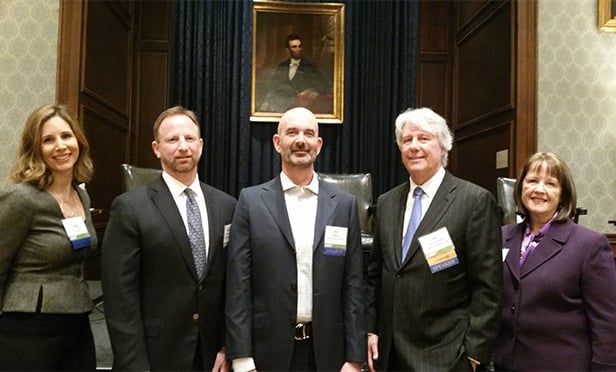
PHILADELPHIA—Understanding suburban residents is critical to producing reimagined and redeveloped communities outside the urban core, say panelists at the Urban Land Institute Philadelphia District's “Contagious Urbanization: How the Suburbs are Embracing Mixed-Use and Density,” held today at the Union League Club.
About 300 attendees were at the program, which offered a regional panel moderated by Fortune Live host and author Leigh Gallagher, a Media, PA native who led a discussion among developers about how they plan and build for the new urbanized Philadelphia suburbs.
Eli Kahn, principal of E. Kahn Development Corp., presented redevelopment plans for downtown West Chester and Devon. As someone who grew up nearby, Eli explained how he aims to create an “urban light” environment, by building walkable and transit-oriented developments that are desirable to those used to a bustling city atmosphere. As previously reported by GlobeSt.com, Kahn successfully redeveloped a former insurance company headquarters in Malvern, PA, which was leased by building products company Saint-Gobain. Last week Kahn sold the property to Chicago developer 90 North.
Devon Yards, his latest project located in the former Waterloo Gardens property, includes the underground parking, an innovative commercial real estate choice, as well as trendy retail described as an “Urban Outfitters themed complex.”
Understanding what makes suburban real estate attractive to its target audience is essential to success, say the panelists.
James Mazzarelli, senior vice president at Liberty Property Trust, pointed out that the Great Valley Corporate Center is being rebuilt with the new decision makers – Gen X, Gen Y and other “digital natives” – in mind. By building active and collaborative work environments that fit into the increasingly common live/work/play lifestyle, Liberty Property Trust hopes properties like his can help set the bar for placemaking in suburban office spaces, he says.
Millennials and empty-nesters tend to have active lifestyles, so when redeveloping the Granite Run Mall, Michael Markman, president of BET Investments, says he knew they would have to incorporate public greenspaces. Markman says the roadmap for this project included speaking with key stakeholders and educating community members on their plans for what he called a “multipurpose desire destination” throughout the process. By building around a walkable courtyard that connects to the adjacent trail system, the new Granite Run Mall encourages patrons to live sustainably while still enjoying their leisure time.
Providing the community and government perspective, Terry Woodman, principal and special consulting projects and manager of East Whiteland Township (Chester County), gave insight as to how municipalities work with developers towards a common goal.
Suburbs are now ready to “put density where the infrastructure is,” she says, which is partly why so many mixed-use projects are in the works. As a veteran of the industry, Woodman stressed the importance of including the entire community in an open dialogue every step of the way. Developers, she says, should “work collaboratively with the township to build real estate, we can all ensure community value with a project.”
Panelists also fielded questions on the importance of public transit access, building for Millennials, young professionals and empty nesters, as well as addressing the “adult Disneyland” and other stigmas surrounding new mixed-use developments.
PHILADELPHIA—Understanding suburban residents is critical to producing reimagined and redeveloped communities outside the urban core, say panelists at the Urban Land Institute Philadelphia District's “Contagious Urbanization: How the Suburbs are Embracing Mixed-Use and Density,” held today at the Union League Club.
About 300 attendees were at the program, which offered a regional panel moderated by Fortune Live host and author Leigh Gallagher, a Media, PA native who led a discussion among developers about how they plan and build for the new urbanized Philadelphia suburbs.
Eli Kahn, principal of E. Kahn Development Corp., presented redevelopment plans for downtown West Chester and Devon. As someone who grew up nearby, Eli explained how he aims to create an “urban light” environment, by building walkable and transit-oriented developments that are desirable to those used to a bustling city atmosphere. As previously reported by GlobeSt.com, Kahn successfully redeveloped a former insurance company headquarters in Malvern, PA, which was leased by building products company Saint-Gobain. Last week Kahn sold the property to Chicago developer 90 North.
Devon Yards, his latest project located in the former Waterloo Gardens property, includes the underground parking, an innovative commercial real estate choice, as well as trendy retail described as an “
Understanding what makes suburban real estate attractive to its target audience is essential to success, say the panelists.
James Mazzarelli, senior vice president at Liberty Property Trust, pointed out that the Great Valley Corporate Center is being rebuilt with the new decision makers – Gen X, Gen Y and other “digital natives” – in mind. By building active and collaborative work environments that fit into the increasingly common live/work/play lifestyle, Liberty Property Trust hopes properties like his can help set the bar for placemaking in suburban office spaces, he says.
Millennials and empty-nesters tend to have active lifestyles, so when redeveloping the Granite Run Mall, Michael Markman, president of BET Investments, says he knew they would have to incorporate public greenspaces. Markman says the roadmap for this project included speaking with key stakeholders and educating community members on their plans for what he called a “multipurpose desire destination” throughout the process. By building around a walkable courtyard that connects to the adjacent trail system, the new Granite Run Mall encourages patrons to live sustainably while still enjoying their leisure time.
Providing the community and government perspective, Terry Woodman, principal and special consulting projects and manager of East Whiteland Township (Chester County), gave insight as to how municipalities work with developers towards a common goal.
Suburbs are now ready to “put density where the infrastructure is,” she says, which is partly why so many mixed-use projects are in the works. As a veteran of the industry, Woodman stressed the importance of including the entire community in an open dialogue every step of the way. Developers, she says, should “work collaboratively with the township to build real estate, we can all ensure community value with a project.”
Panelists also fielded questions on the importance of public transit access, building for Millennials, young professionals and empty nesters, as well as addressing the “adult Disneyland” and other stigmas surrounding new mixed-use developments.
© Arc, All Rights Reserved. Request academic re-use from www.copyright.com. All other uses, submit a request to TMSalesOperations@arc-network.com. For more information visit Asset & Logo Licensing.