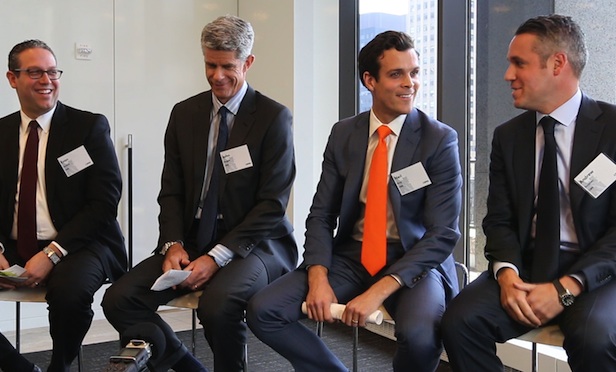
NEW YORK CITY—In an era when location, location, location is no longer the mantra for finding the right office space—with the nature of the space instead dictating whether a lease is signed—office buildings need to feature amenities that go above and beyond what's expected, said several CBRE brokerage professionals during a recent panel discussion on the city's office leasing trends, held at the firm's Midtown headquarters.
“It's no longer enough to have a building in the heart of the city with a renovated lobby,” declared Evan Haskell, SVP. “Landlords need a building with 21st century amenities to attract 21st century tenants.”
Added SVP Neil King, “Amenities that were great to have five to 10 years ago—like setbacks that became terraces, rooftop areas as common amenities, building gyms—are now pre-requisites. Now, we look at how we can bring a building's architectural bones to life and how to change a property's retail landscape.”
He continued, “At one building, we're approaching retail tenants who aren't a good fit to buy them out and offering other retailers a sweetheart deal because we know they will drive rents. We're also looking at whether to build an amphitheater for landlord sponsored events and can we get food trucks to come two times a week to drive interest.”
At 787 11th Ave., which sits across the street from Mercedes House, “the best gym in the city,” noted Haskell—tenants are being offered membership discounts or even joining for free, creating a “neighborhood feel to the amenities.” Another office tower he's working with has put in a rooftop tennis court and a third, 425 Park Ave., is putting in a full-service restaurant backed by the culinary professionals behind 11 Madison Park and the Nomad.”
Asserted King, “It's about creating a lifestyle for tenants, plus the amenities are partly due to the power of the young work force. Those amenities are a powerful recruiting tool.”
Amenities combined with changes around the city have lowered the priority level of neighborhood when office tenants are choosing space, opined Andrew Sussman, vice chairman.
“Tenants love new construction and there's not a lot of that in Midtown but there is some Downtown,” he said. “Also, the increasing urbanization of America has given a real elasticity to the boundaries of a business community. Tenants need to be oriented to transit access but they no longer need to be near a mass transit hub.”
In addition, Sussman continued, “Transportation has improved so tenants can rationalize moving to locations that are easier to get to now than they were 15 to 20 years ago.”
For exampled, continued Haskell, “What is happening from a residential standpoint in Brooklyn, on the New Jersey waterfront and in Lower Manhattan is tied to the transition of Downtown into a vibrant office market because these areas have become extremely popular locations for top talent. This has been a big driver for many of the 11 million square feet of tenants who have chosen to relocate from Midtown or Midtown South to Lower Manhattan.”
Ultimately, there's a mindshift in the market, prompted by the search for efficient space.
“Tenants that in the past would only consider the Plaza District or Park Avenue are looking to trendier neighborhoods,” said vice chairman John Nugent. “We saw that with IBM's move from Time Square to Astor Place and Cadillac started in Midtown, looked Downtown and in Brooklyn before taking space at 330 Hudson St.
“We're also seeing family offices starting to look in the Meatpacking District and places beyond the plaza district,” he revealed. “That's a real change.”
“Better use of space—including increased density—is first and foremost today,” added Sussman. “Tenants need efficient space that enhances collaboration and puts their brand on the map. They can use that as a recruiting tool.”
“It's no longer enough to have a building in the heart of the city with a renovated lobby,” declared Evan Haskell, SVP. “Landlords need a building with 21st century amenities to attract 21st century tenants.”
Added SVP Neil King, “Amenities that were great to have five to 10 years ago—like setbacks that became terraces, rooftop areas as common amenities, building gyms—are now pre-requisites. Now, we look at how we can bring a building's architectural bones to life and how to change a property's retail landscape.”
He continued, “At one building, we're approaching retail tenants who aren't a good fit to buy them out and offering other retailers a sweetheart deal because we know they will drive rents. We're also looking at whether to build an amphitheater for landlord sponsored events and can we get food trucks to come two times a week to drive interest.”
At 787 11th Ave., which sits across the street from Mercedes House, “the best gym in the city,” noted Haskell—tenants are being offered membership discounts or even joining for free, creating a “neighborhood feel to the amenities.” Another office tower he's working with has put in a rooftop tennis court and a third, 425 Park Ave., is putting in a full-service restaurant backed by the culinary professionals behind 11 Madison Park and the Nomad.”
Asserted King, “It's about creating a lifestyle for tenants, plus the amenities are partly due to the power of the young work force. Those amenities are a powerful recruiting tool.”
Amenities combined with changes around the city have lowered the priority level of neighborhood when office tenants are choosing space, opined Andrew Sussman, vice chairman.
“Tenants love new construction and there's not a lot of that in Midtown but there is some Downtown,” he said. “Also, the increasing urbanization of America has given a real elasticity to the boundaries of a business community. Tenants need to be oriented to transit access but they no longer need to be near a mass transit hub.”
In addition, Sussman continued, “Transportation has improved so tenants can rationalize moving to locations that are easier to get to now than they were 15 to 20 years ago.”
For exampled, continued Haskell, “What is happening from a residential standpoint in Brooklyn, on the New Jersey waterfront and in Lower Manhattan is tied to the transition of Downtown into a vibrant office market because these areas have become extremely popular locations for top talent. This has been a big driver for many of the 11 million square feet of tenants who have chosen to relocate from Midtown or Midtown South to Lower Manhattan.”
Ultimately, there's a mindshift in the market, prompted by the search for efficient space.
“Tenants that in the past would only consider the Plaza District or Park Avenue are looking to trendier neighborhoods,” said vice chairman John Nugent. “We saw that with IBM's move from Time Square to Astor Place and Cadillac started in Midtown, looked Downtown and in Brooklyn before taking space at 330 Hudson St.
“We're also seeing family offices starting to look in the Meatpacking District and places beyond the plaza district,” he revealed. “That's a real change.”
“Better use of space—including increased density—is first and foremost today,” added Sussman. “Tenants need efficient space that enhances collaboration and puts their brand on the map. They can use that as a recruiting tool.”
© Arc, All Rights Reserved. Request academic re-use from www.copyright.com. All other uses, submit a request to TMSalesOperations@arc-network.com. For more information visit Asset & Logo Licensing.