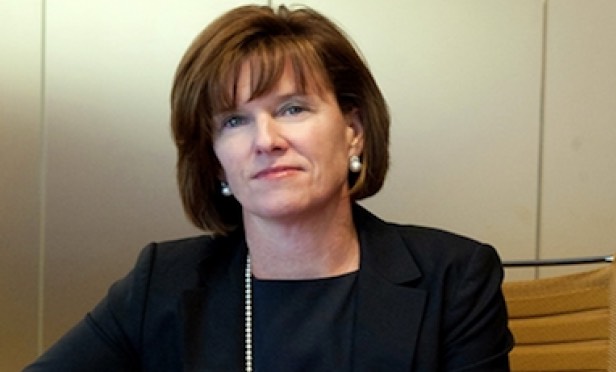
BETHESDA, MD—“After completing an incredibly strong 2015 for multifamily, we still see a sense of optimism for 2016, but it's tempered with caution,” says Grace Huebscher, president of Capital One Multifamily Finance. “Most multifamily professionals believe there is reason to expect another strong year, but past down cycles are not-so-distant memories.”
Huebscher is commenting on the results of Capital One Multifamily Finance's survey of industry professionals, conducted at a Capital One event during the National Multifamily Housing Council's recent Annual Conference, which found that 57% don't think the market is overheated. However, that still leaves a substantial minority who think it is.
The multifamily finance veteran recently blogged about the results on the Capital One website. “I was struck when one of our clients described the atmosphere at the National Multifamily Housing Conference in January as 'insecure optimism,' ” wrote Huebscher. “I thought he captured the mood exactly.”
While there is plenty to be optimistic about—not least the currently low homeownership rate—Huebscher wrote that attendees at the NMHC conference seemed less than sanguine. “Capital One typically conducts a survey at industry events, and this time around respondents split evenly in their assessment of where we stand in the cycle,” she wrote. “The same percentage said 'middle' as 'late middle.' When asked if the markets are overheated, 57% answered 'no,' while 43% said 'yes.' Sounds like insecure optimism.”
Counterbalancing that is the fact those who were divided evenly on whether the market is in mid- or late mid-cycle constituted a large majority when taken together (97%). Just 8% think we're near the end of the cycle.
Top concern among the 110 professionals surveyed by Capital One Multifamily Finance was global economic conditions, cited by 41% of respondents. Another 26% said they're most concerned about valuations, potentially reflecting international confidence in the multifamily market.
“Many industry expectations and concerns uncovered through this survey are closely related,” says Huebscher. “For example, global economic volatility can affect valuations, as the US multifamily is viewed favorably by international investors. Commercial real estate professionals are smart to track these issues closely.”
That's especially the case when cross-border investment plays such a significant role in the overall sales volume for a sector, as was the case for multifamily last year. Foreign buyers figured in more than $25 billion of the $150 billion in significant US apartment sales in '15, according to Real Capital Analytics. With a 180% year-over-year increase, cross-border investment in domestic multifamily increased more than five times as fast as overall sales volume in the sector.
Forty-six percent of NMHC conference attendees surveyed believe that debt lending standards are measured. About one-third of respondents believe lending standards are aggressive, but 20% report that they could be more aggressive.
Although most survey respondents (45%) expect to be most active in urban markets during 2016, the Capital One Multifamily Finance survey also found a strong interest in non-urban markets. Twenty-one percent of multifamily professionals expect to be most active in suburban markets, followed closely by tertiary markets at 18%. Sixteen percent of respondents report that they will generally have the same level of activity across all markets this year.
BETHESDA, MD—“After completing an incredibly strong 2015 for multifamily, we still see a sense of optimism for 2016, but it's tempered with caution,” says Grace Huebscher, president of
Huebscher is commenting on the results of
The multifamily finance veteran recently blogged about the results on the
While there is plenty to be optimistic about—not least the currently low homeownership rate—Huebscher wrote that attendees at the NMHC conference seemed less than sanguine. “
Counterbalancing that is the fact those who were divided evenly on whether the market is in mid- or late mid-cycle constituted a large majority when taken together (97%). Just 8% think we're near the end of the cycle.
Top concern among the 110 professionals surveyed by
“Many industry expectations and concerns uncovered through this survey are closely related,” says Huebscher. “For example, global economic volatility can affect valuations, as the US multifamily is viewed favorably by international investors. Commercial real estate professionals are smart to track these issues closely.”
That's especially the case when cross-border investment plays such a significant role in the overall sales volume for a sector, as was the case for multifamily last year. Foreign buyers figured in more than $25 billion of the $150 billion in significant US apartment sales in '15, according to Real Capital Analytics. With a 180% year-over-year increase, cross-border investment in domestic multifamily increased more than five times as fast as overall sales volume in the sector.
Forty-six percent of NMHC conference attendees surveyed believe that debt lending standards are measured. About one-third of respondents believe lending standards are aggressive, but 20% report that they could be more aggressive.
Although most survey respondents (45%) expect to be most active in urban markets during 2016, the
© Arc, All Rights Reserved. Request academic re-use from www.copyright.com. All other uses, submit a request to TMSalesOperations@arc-network.com. For more information visit Asset & Logo Licensing.