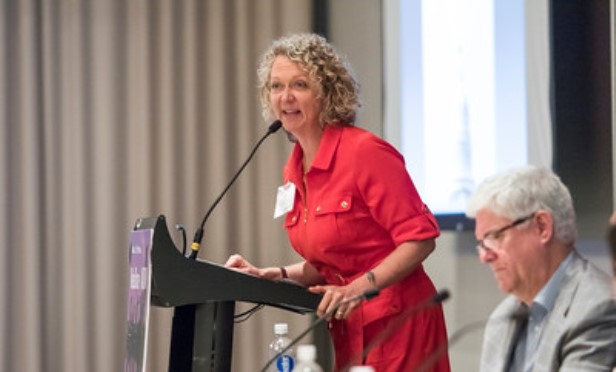
AUSTIN, TX—The preferences of the millennial generation and transportation issues, particularly how a potential decrease in downtown parking coupled with the retreat of ride-sharing companies impacts the city, took center stage at RealShare AUSTIN, held here June 2 at the W Hotel. Not surprisingly, millennial was the topic of the day beginning with developers discussing ride sharing and the possibility of dissipating parking facilities.
“We're trying to find a balance,” said Matt Mathias, principal of Mathias Partners, in response to whether parking garages will soon become obsolete as the growth of walkable communities gain strength.
“The lines are blurring with millennials taking over,” said Molly Alexander, executive vice president of economic development, Downtown Alliance. “They are changing the past and expecting more than a place to live or work. They want an overall experience, and the commercial real estate industry is being turned on its ear. In my 25 years in the industry, this is the first time I've seen this type of occurrence at a such a rapid pace when discussing the shaping of the physical environment and real estate property.”
So is this a trend or a movement? Alexander explained the younger generation today wants to be in Austin's inner city and will trade off car ownership and other things to live in what they consider the “dream hood” as opposed to the “dream home” and for Austin that typically encompasses downtown.
Empty nesters are jumping on the bandwagon as well. Logan Kimble, senior development manager of Brookfield Residential, believes the 55+ community wants the same space and amenities as millennials, albeit with different motivation. Brookfield is building to the generations looking for smaller living spaces and larger communal, outdoor property.
“We are banking on this being a movement and not a trend,” Kimble explained. “We are catering to the millennials and empty nesters alike.”
Transition was a theme that resounded throughout the show and permeates all sectors of the commercial real estate industry—from development to capital markets to multifamily.
Understanding Austin's transportation issue was a huge subject within the development panel as the Austin hotels move toward becoming no parking facilities. Here, the idea of eliminating parking downtown altogether was discussed.
“I think the concept of a lower parking ratio is beginning to take hold, and it makes sense,” said Chad Marsh, managing principal of Endeavor Real Estate.
However, he believes Austin made a mistake in voting yes to the law requiring mandatory fingerprint-based criminal background checks for new ride sharing drivers within Austin city limits. As a result, ride sharing companies Uber and Lyft have shut down operations in the city. This could greatly affect the Austin economy for the long term, according to JMI's Taylor Vreeland, who explained how groups that may be planning large meetings and conventions in Austin will be forced to rethink having an event in a city without ride sharing for thousands of people.
“The Austin economy and job growth can be significantly impacted if ride sharing doesn't return to the city.”
In conjunction with the movement, downtown is attracting a new type of office tenant. Developers are now having to embrace a true live, work, play attitude, and the office sector is no exception. Amenities are high on the list of millennials.
“Downtown has a strong office market with tech being the driving sector,” explained Marsh.
In illustration, Alexander noted, “Ten years ago property managers were not concerned with dogs coming to work or the need to acquire a liquor license for an office building.”
With 13% of Austin's millennials living in suburban communities, Bill Redd, executive vice president and senior managing director of Brandywine Realty Trust explained, “The amenities package is mandatory in office. Tenants want outdoor space, restaurants, recreation, and we're trying to find ways to remain relevant in the urban—and suburban—communities. We're looking to redevelop properties into walkable, mixed use, recreation, amenity-laden properties and trying to find ways to remain relevant.”
This trend toward smaller units really began in the mid-'90s before the millennials began renting apartments. In 1994, the size of an average one-bedroom apartment in Austin was 800 square feet. By the the early 2000s the average size was down to 750 square feet. Now it's 600 square feet, 25% smaller than 22 years ago. The micro-unit is an extension of this, with Transwestern's announcement of the first micro-unit, Indie apartments, in East Austin two years ago. These micro-units range in size from 350 square feet for a studio to 520 square feet for a two-bedroom unit.
Micro-units are growing in popularity in Austin as well as nationally as millennials and others seek lower-cost housing options close to amenities. The idea is that their personal incomes aren't growing as fast as rental rates in most areas, yet they want to live in the middle of restaurants, bars and entertainment areas. To convince investors to take on the project, the company's development team started looking at the value proposition back in 2014.
“We solidified the demand for the micro-units more than 24 months ago,” said Robert Gaston, executive vice president, Transwestern. “Once we began working with our capital investors and traditional lenders, we were able to create a plan for micro-units.”
He explained how this is meeting the demand for the millennial lifestyle–the desire to have quality over size. It's also about reacting to the fact that millennials have more student debt than any other generation and have not experienced the same income growth that baby boomers and gen Xers did. Among other things, Transwestern's micro-units meet a financial need for Austin's millennial generation.
“We're pleased with what we've come up with,” Gaston said, adding that 600 multifamily units are opening now with a creative office space.
AUSTIN, TX—The preferences of the millennial generation and transportation issues, particularly how a potential decrease in downtown parking coupled with the retreat of ride-sharing companies impacts the city, took center stage at RealShare AUSTIN, held here June 2 at the W Hotel. Not surprisingly, millennial was the topic of the day beginning with developers discussing ride sharing and the possibility of dissipating parking facilities.
“We're trying to find a balance,” said Matt Mathias, principal of Mathias Partners, in response to whether parking garages will soon become obsolete as the growth of walkable communities gain strength.
“The lines are blurring with millennials taking over,” said Molly Alexander, executive vice president of economic development, Downtown Alliance. “They are changing the past and expecting more than a place to live or work. They want an overall experience, and the commercial real estate industry is being turned on its ear. In my 25 years in the industry, this is the first time I've seen this type of occurrence at a such a rapid pace when discussing the shaping of the physical environment and real estate property.”
So is this a trend or a movement? Alexander explained the younger generation today wants to be in Austin's inner city and will trade off car ownership and other things to live in what they consider the “dream hood” as opposed to the “dream home” and for Austin that typically encompasses downtown.
Empty nesters are jumping on the bandwagon as well. Logan Kimble, senior development manager of Brookfield Residential, believes the 55+ community wants the same space and amenities as millennials, albeit with different motivation. Brookfield is building to the generations looking for smaller living spaces and larger communal, outdoor property.
“We are banking on this being a movement and not a trend,” Kimble explained. “We are catering to the millennials and empty nesters alike.”
Transition was a theme that resounded throughout the show and permeates all sectors of the commercial real estate industry—from development to capital markets to multifamily.
Understanding Austin's transportation issue was a huge subject within the development panel as the Austin hotels move toward becoming no parking facilities. Here, the idea of eliminating parking downtown altogether was discussed.
“I think the concept of a lower parking ratio is beginning to take hold, and it makes sense,” said Chad Marsh, managing principal of Endeavor Real Estate.
However, he believes Austin made a mistake in voting yes to the law requiring mandatory fingerprint-based criminal background checks for new ride sharing drivers within Austin city limits. As a result, ride sharing companies Uber and Lyft have shut down operations in the city. This could greatly affect the Austin economy for the long term, according to JMI's Taylor Vreeland, who explained how groups that may be planning large meetings and conventions in Austin will be forced to rethink having an event in a city without ride sharing for thousands of people.
“The Austin economy and job growth can be significantly impacted if ride sharing doesn't return to the city.”
In conjunction with the movement, downtown is attracting a new type of office tenant. Developers are now having to embrace a true live, work, play attitude, and the office sector is no exception. Amenities are high on the list of millennials.
“Downtown has a strong office market with tech being the driving sector,” explained Marsh.
In illustration, Alexander noted, “Ten years ago property managers were not concerned with dogs coming to work or the need to acquire a liquor license for an office building.”
With 13% of Austin's millennials living in suburban communities, Bill Redd, executive vice president and senior managing director of Brandywine Realty Trust explained, “The amenities package is mandatory in office. Tenants want outdoor space, restaurants, recreation, and we're trying to find ways to remain relevant in the urban—and suburban—communities. We're looking to redevelop properties into walkable, mixed use, recreation, amenity-laden properties and trying to find ways to remain relevant.”
This trend toward smaller units really began in the mid-'90s before the millennials began renting apartments. In 1994, the size of an average one-bedroom apartment in Austin was 800 square feet. By the the early 2000s the average size was down to 750 square feet. Now it's 600 square feet, 25% smaller than 22 years ago. The micro-unit is an extension of this, with Transwestern's announcement of the first micro-unit, Indie apartments, in East Austin two years ago. These micro-units range in size from 350 square feet for a studio to 520 square feet for a two-bedroom unit.
Micro-units are growing in popularity in Austin as well as nationally as millennials and others seek lower-cost housing options close to amenities. The idea is that their personal incomes aren't growing as fast as rental rates in most areas, yet they want to live in the middle of restaurants, bars and entertainment areas. To convince investors to take on the project, the company's development team started looking at the value proposition back in 2014.
“We solidified the demand for the micro-units more than 24 months ago,” said Robert Gaston, executive vice president, Transwestern. “Once we began working with our capital investors and traditional lenders, we were able to create a plan for micro-units.”
He explained how this is meeting the demand for the millennial lifestyle–the desire to have quality over size. It's also about reacting to the fact that millennials have more student debt than any other generation and have not experienced the same income growth that baby boomers and gen Xers did. Among other things, Transwestern's micro-units meet a financial need for Austin's millennial generation.
“We're pleased with what we've come up with,” Gaston said, adding that 600 multifamily units are opening now with a creative office space.
© Arc, All Rights Reserved. Request academic re-use from www.copyright.com. All other uses, submit a request to TMSalesOperations@arc-network.com. For more information visit Asset & Logo Licensing.