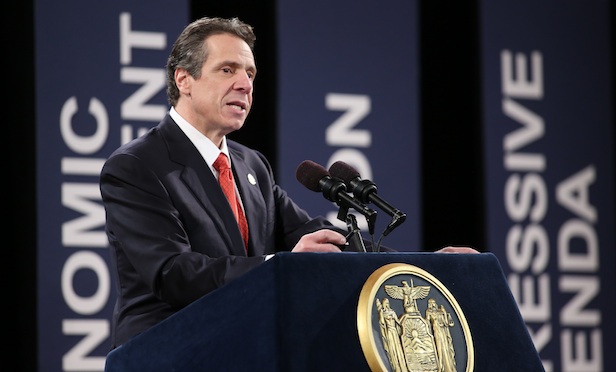
ALBANY, NY—Undoubtedly looking to get a replacement for 421a on the books, Governor Andrew Cuomo has offered developers an olive branch. Industry attorneys praised the move to GlobeSt.com.
The state has offered developers and union officials a wage subsidy for construction workers, according to the New York Times. The tax abatement program expired when the two groups failed to come to an agreement on wages.
More specifically, the offering's future began to look dim 16 months ago when the Governor declared that he would not renew the legislation governing the tax abatement unless it mandated developers to pay union-level wages in order to qualify.
REBNY pushed back, noting that higher wages would increase construction costs by up to 30%, resulting in fewer subsidized units, or bigger subsidies, the Times reports.
Union leaders countered that developers who got generous public subsidies should not get away with paying low wages. The two sides never came to terms, allowing the 421-a program to expire in January. Predictions of a freeze in multifamily development emerged and, by several measures, came to fruition.
Although the governor's latest salvo in this battle reportedly was made after secret meetings in recent weeks with Bill Mulrow, the governor's secretary; John Banks, president of REBNY and Gary LaBarbera, president of the Building and Construction Trades Council, no signal has been sent up yet regarding approval by the relevant parties.
In a statement provided to GlobeSt.com, Banks only would say, “One of the greatest challenges facing New York City is the need to create multifamily rental housing, particularly with significant below-market, or affordable units. Such development simply is not possible without a tax abatement program like 421-a. We remain committed to engaging in a dialogue with stakeholders to enact a plan to create affordable rental housing.”
The suggested need for continuing discussion may come, in part, from the lack of specificity offered up in the Governor's proposal, notes Crain's New York Business.
It is unclear where the wage subsidy—which could cost tens of millions of dollars—would come from or how the program would be managed, Crain's notes, yet the proposal assures developers that they would not be required to hire a union work force, or to pay “prevailing,” or union-level, wages.
The plan would, however, set a two-tiered minimum wage for projects of 300 apartments or more in Manhattan and on the waterfront in Brooklyn and Queens. In Manhattan, south of 96th Street, any project seeking 421-a property tax abatements would have to pay an average wage of “no less than” $65 an hour, including benefits.
Developers of projects on the East River in Queens and Brooklyn would pay $50 an hour in wages and benefits—but 30%, or $15 an hour, would be reimbursed by New York State, according to a memo distributed to builders earlier this week.
A requirement for developers to set aside 25% to 30% of the units in a project for below-market rents also would be in place under the new program.
Commercial real estate lawyers gave GlobeSt.com their feedback on the Governor's plan.
“While the details are not clear, the 300 apartment unit threshold is a major step towards reinstating the 421-a program,” asserts David Pfeffer, chair of the construction practice at Tarter Krinsky & Drogin. “Most developers building projects of more than 300 units will price in union labor during the planning phase of a project because, among other things, it is difficult to gather the number of trade workers, like plumbers, electricians and carpenters, without going union.
He continues, “The proposed partial reimbursement by New York State is a way for the State to help bridge the gap between the unions and developers. This proposal could very well be the impetus for the reinstatement of New York's 421-a program.”
Agrees Martin Heistein of Belkin Burden Wenig & Goldman, “This is an excellent attempt by the Governor to revive the 421-a rent abatement program, which will once again be an incentive for owners to build new residential buildings. New York has a critical need for more housing and without the 421-a tax abatement and new residential construction, New York's economy will be devastated.”
Steady gains in the US economy have resulted in net positives for the multifamily sector—will this wave continue for the foreseeable future? What's driving development and capital flows? Join us at RealShare Apartments on October 19 & 20 for impactful information from the leaders in the National multifamily space. Learn more.
ALBANY, NY—Undoubtedly looking to get a replacement for 421a on the books, Governor Andrew Cuomo has offered developers an olive branch. Industry attorneys praised the move to GlobeSt.com.
The state has offered developers and union officials a wage subsidy for construction workers, according to the
More specifically, the offering's future began to look dim 16 months ago when the Governor declared that he would not renew the legislation governing the tax abatement unless it mandated developers to pay union-level wages in order to qualify.
REBNY pushed back, noting that higher wages would increase construction costs by up to 30%, resulting in fewer subsidized units, or bigger subsidies, the Times reports.
Union leaders countered that developers who got generous public subsidies should not get away with paying low wages. The two sides never came to terms, allowing the 421-a program to expire in January. Predictions of a freeze in multifamily development emerged and, by several measures, came to fruition.
Although the governor's latest salvo in this battle reportedly was made after secret meetings in recent weeks with Bill Mulrow, the governor's secretary; John Banks, president of REBNY and Gary LaBarbera, president of the Building and Construction Trades Council, no signal has been sent up yet regarding approval by the relevant parties.
In a statement provided to GlobeSt.com, Banks only would say, “One of the greatest challenges facing
The suggested need for continuing discussion may come, in part, from the lack of specificity offered up in the Governor's proposal, notes Crain's
It is unclear where the wage subsidy—which could cost tens of millions of dollars—would come from or how the program would be managed, Crain's notes, yet the proposal assures developers that they would not be required to hire a union work force, or to pay “prevailing,” or union-level, wages.
The plan would, however, set a two-tiered minimum wage for projects of 300 apartments or more in Manhattan and on the waterfront in Brooklyn and Queens. In Manhattan, south of 96th Street, any project seeking 421-a property tax abatements would have to pay an average wage of “no less than” $65 an hour, including benefits.
Developers of projects on the East River in Queens and Brooklyn would pay $50 an hour in wages and benefits—but 30%, or $15 an hour, would be reimbursed by
A requirement for developers to set aside 25% to 30% of the units in a project for below-market rents also would be in place under the new program.
Commercial real estate lawyers gave GlobeSt.com their feedback on the Governor's plan.
“While the details are not clear, the 300 apartment unit threshold is a major step towards reinstating the 421-a program,” asserts David Pfeffer, chair of the construction practice at Tarter Krinsky & Drogin. “Most developers building projects of more than 300 units will price in union labor during the planning phase of a project because, among other things, it is difficult to gather the number of trade workers, like plumbers, electricians and carpenters, without going union.
He continues, “The proposed partial reimbursement by
Agrees Martin Heistein of
Steady gains in the US economy have resulted in net positives for the multifamily sector—will this wave continue for the foreseeable future? What's driving development and capital flows? Join us at RealShare Apartments on October 19 & 20 for impactful information from the leaders in the National multifamily space. Learn more.
© Arc, All Rights Reserved. Request academic re-use from www.copyright.com. All other uses, submit a request to TMSalesOperations@arc-network.com. For more information visit Asset & Logo Licensing.