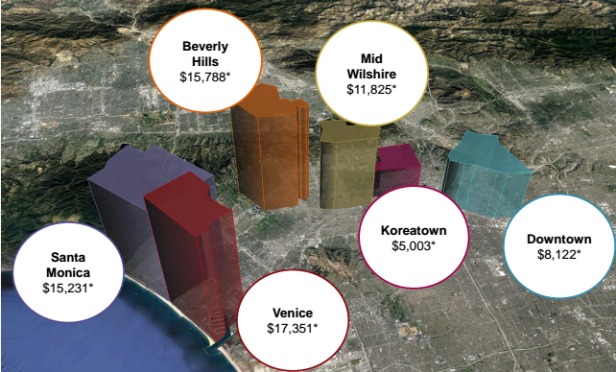
LOS ANGELES—Venice is leading the Los Angeles market in retail spending. JLL surveyed retail spending in Los Angeles submarkets and found that Venice sees $17,351 in retail spending per capita, higher than both Beverly Hills and Santa Monica, respectively. While Venice has one of the most coveted retail streets, Abbott Kinney, it is surprising to see the market perform above Los Angeles' internationally admired retail markets.
“Venice is a smaller micro market and it has one of the hottest streets in the city in Abbott Kinney,” Scott Burns, EVP at JLL, tells GlobeSt.com. “It has some really interesting draws and it has really come into its own in the last couple of years. That is a trend that we have been watching closely. You have a great amount of sales coming out of a very tight area there. It isn't has big as Downtown or Santa Monica geographically.”
The high retail spending numbers have translated into tight vacancy rates and increasing rents, but Burns says that, while the market has grown in recent years, it has always been a strong market for retail. “Venice is and always has been a very desirable area,” he explains. “The residential population is gentrifying, and the small bungalows there were $500,000 properties and now they are well over $1 million. Plus, it is right in the middle of Silicon Beach. I don't think the desirability from a retailer standpoint is going to change looking at this map, but it is going to be difficult to find something. The majority of the market is not designed for large retailers, so many of the retailers that are there are boutiques or chef-driven restaurants.”
Markets like Downtown and Koreatown bottomed out the list, bringing in $8,122 and $5,003 per capita. The Downtown market is still growing, and Burns expects more consumers to go Downtown as the market grows. “Downtown is here to stay, and it is continuing to improve,” he says. “The retailers have identified the market as a good location, but it needs time to continue to mature. As Broadway continues to revitalize, you will see more retailers down there that will draw from a greater distance. It is all part of it, and it is where I would have expected it to be. In five years from now, it will look a lot different.”
Even then, Burns isn't convinced that the retail market in Downtown will ever compete with more popular and accessible markets like Venice, Santa Monica and Beverly Hills. Downtown is built to be a self-sustaining market—a live-work-play environment—while Venice and Santa Monica are at the epicenter of Silicon Beach. “If you look at the density of residential in Santa Monica and Venice, there are a lot of communities between those cities, like Brentwood, Marina del Rey and Mar Vista,” adds Burns. “Downtown L.A. is almost a market unto itself. You need to create density and bring in transit.”
LOS ANGELES—Venice is leading the Los Angeles market in retail spending. JLL surveyed retail spending in Los Angeles submarkets and found that Venice sees $17,351 in retail spending per capita, higher than both Beverly Hills and Santa Monica, respectively. While Venice has one of the most coveted retail streets, Abbott Kinney, it is surprising to see the market perform above Los Angeles' internationally admired retail markets.
“Venice is a smaller micro market and it has one of the hottest streets in the city in Abbott Kinney,” Scott Burns, EVP at JLL, tells GlobeSt.com. “It has some really interesting draws and it has really come into its own in the last couple of years. That is a trend that we have been watching closely. You have a great amount of sales coming out of a very tight area there. It isn't has big as Downtown or Santa Monica geographically.”
The high retail spending numbers have translated into tight vacancy rates and increasing rents, but Burns says that, while the market has grown in recent years, it has always been a strong market for retail. “Venice is and always has been a very desirable area,” he explains. “The residential population is gentrifying, and the small bungalows there were $500,000 properties and now they are well over $1 million. Plus, it is right in the middle of Silicon Beach. I don't think the desirability from a retailer standpoint is going to change looking at this map, but it is going to be difficult to find something. The majority of the market is not designed for large retailers, so many of the retailers that are there are boutiques or chef-driven restaurants.”
Markets like Downtown and Koreatown bottomed out the list, bringing in $8,122 and $5,003 per capita. The Downtown market is still growing, and Burns expects more consumers to go Downtown as the market grows. “Downtown is here to stay, and it is continuing to improve,” he says. “The retailers have identified the market as a good location, but it needs time to continue to mature. As Broadway continues to revitalize, you will see more retailers down there that will draw from a greater distance. It is all part of it, and it is where I would have expected it to be. In five years from now, it will look a lot different.”
Even then, Burns isn't convinced that the retail market in Downtown will ever compete with more popular and accessible markets like Venice, Santa Monica and Beverly Hills. Downtown is built to be a self-sustaining market—a live-work-play environment—while Venice and Santa Monica are at the epicenter of Silicon Beach. “If you look at the density of residential in Santa Monica and Venice, there are a lot of communities between those cities, like Brentwood, Marina del Rey and Mar Vista,” adds Burns. “Downtown L.A. is almost a market unto itself. You need to create density and bring in transit.”
© Arc, All Rights Reserved. Request academic re-use from www.copyright.com. All other uses, submit a request to TMSalesOperations@arc-network.com. For more information visit Asset & Logo Licensing.