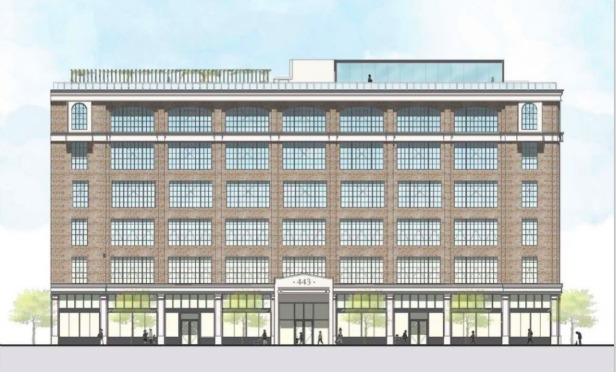
LOS ANGELES—Catalina Lofts is shaping up to be a noteworthy development. It is one of the first redevelopment projects on Skid Row, which brings the DTLA renaissance to the neighborhood, and it is also one of the first projects under the new non-ductile concrete mandatory seismic reinforcement ordinance. The new regulations have added a significant costs to the development, approximately $1.5 million to the developer's $1 million structural upgrade budget.
“This building is one of the first to be permitted per the new non-ductile concrete mandatory seismic reinforcement ordinance,” Karin Liljegren, founder of Omgivning, the architect and designer behind the Catalina Lofts, tells GlobeSt.com. “In addition, enforcing agencies have many new structural upgrade requirements. The structural upgrade budget was $1 million, but the costs are now $2.5 million, which was not anticipated by the Developer and making the project difficult to pencil.”
The ordinance requires that any building with a roof or floor supported by a concrete wall or concrete column and constructed before January 13, 1977 must be retrofitted for earthquake safety. As part of the redevelopment project, Catalina Lofts must adhere to these codes.
The non-ductile concrete mandatory seismic reinforcement ordinance is not the only new regulation adding to the cost of the developments. Because the project is a renovation of the entire building, it is triggering other new ordinances as well, like the code regulations. “The roof has been occupied informally for years, the current tenants have little gardens and gathering places all over the roof as it has amazing views of the Downtown skyline,” says Liljegren. “New code compliance dictates that legally using the roof will trigger the entire building to be considered high-rise, even though it is only 6 stories high. This is challenging in that we have to provide many high rise fire life safety systems that a 20- or 40-story building have to provide just to occupy the roof. This is expensive.”
Steady gains in the US economy have resulted in net positives for the multifamily sector—will this wave continue for the foreseeable future? What's driving development and capital flows? Join us at RealShare Apartments on October 19 & 20 for impactful information from the leaders in the National multifamily space. Learn more.
LOS ANGELES—Catalina Lofts is shaping up to be a noteworthy development. It is one of the first redevelopment projects on Skid Row, which brings the DTLA renaissance to the neighborhood, and it is also one of the first projects under the new non-ductile concrete mandatory seismic reinforcement ordinance. The new regulations have added a significant costs to the development, approximately $1.5 million to the developer's $1 million structural upgrade budget.
“This building is one of the first to be permitted per the new non-ductile concrete mandatory seismic reinforcement ordinance,” Karin Liljegren, founder of Omgivning, the architect and designer behind the Catalina Lofts, tells GlobeSt.com. “In addition, enforcing agencies have many new structural upgrade requirements. The structural upgrade budget was $1 million, but the costs are now $2.5 million, which was not anticipated by the Developer and making the project difficult to pencil.”
The ordinance requires that any building with a roof or floor supported by a concrete wall or concrete column and constructed before January 13, 1977 must be retrofitted for earthquake safety. As part of the redevelopment project, Catalina Lofts must adhere to these codes.
The non-ductile concrete mandatory seismic reinforcement ordinance is not the only new regulation adding to the cost of the developments. Because the project is a renovation of the entire building, it is triggering other new ordinances as well, like the code regulations. “The roof has been occupied informally for years, the current tenants have little gardens and gathering places all over the roof as it has amazing views of the Downtown skyline,” says Liljegren. “New code compliance dictates that legally using the roof will trigger the entire building to be considered high-rise, even though it is only 6 stories high. This is challenging in that we have to provide many high rise fire life safety systems that a 20- or 40-story building have to provide just to occupy the roof. This is expensive.”
Steady gains in the US economy have resulted in net positives for the multifamily sector—will this wave continue for the foreseeable future? What's driving development and capital flows? Join us at RealShare Apartments on October 19 & 20 for impactful information from the leaders in the National multifamily space. Learn more.
© Arc, All Rights Reserved. Request academic re-use from www.copyright.com. All other uses, submit a request to TMSalesOperations@arc-network.com. For more information visit Asset & Logo Licensing.