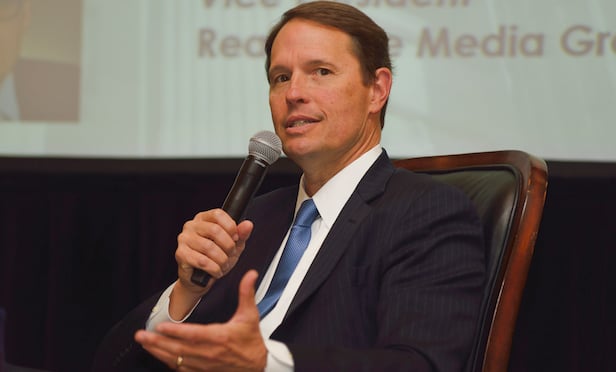
NEW YORK CITY—“We like smart people who are driven to succeed at a high level, who are team players,” Larry Heard told the audience at this year's RealShare National Investment & Finance conference. “The team player is especially important in our company, although I think the business is going that way.
“Assignments are becoming more competitive, and you need to bring more skill sets to the table in order to execute,” said Transwestern's president and CEO. “If your teams are made of 'I' people and not 'we' people, those teams won't work because of the friction. So we look for team-oriented people who take a longer view of things.”
Heard took the stage at RealShare for a one-on-one “Inside the Real Estate Mind” discussion with Michael Desiato, VP of ALM's Real Estate Media Group. During the course of the 45-minute discussion, the 36-year industry veteran held forth on topics ranging from his company's diversification beyond its development origins to the importance of family.
In fact, Heard's start in commercial real estate occurred via an internship, the summer before he graduated Baylor University with a degree in finance, with a Houston-based developer. From that initial exposure to CRE, Heard found that he was “really attracted to the pace of the business and the diversity of what you did during the day. The idea of going to meet with the architect, and the meeting with the contractor and then going to the bank to try to borrow money, then trying to get your properties leased. Every day was a different day. It tests all of our capacities for what we can achieve.”
Heard found that his early years in the industry tested his capacity, and that of his colleagues, in quite a different way. ” I got in right before the oil bust,” he recalled. ” I came into the business in 1980 and joined Transwestern in 1983. The oil bust occurred in 1984, so for four years I thought, 'wow, this is easy.' But then when the oil bust happened, it was brutal, especially in Texas.
“ At the time we did basically one thing, which was development,” he continued. “We had a lot of cash flow but no liquidity. We built 57 projects with 37 different lenders over a six- or seven-year period. Then the liquidity dried up and we were all dressed up with nowhere to go.”
Following a couple of “grueling years,” Heard said, “we diversified our business into a more dynamic company from the standpoint of services. We did a lot of leasing, a lot of property management, investment sales to basically survive in the late '80s. When we came out of that, as a group we said 'we're never going to do one thing again. We're going to stay diversified,' and we've been that way ever since. We've diversified geographically, and we've diversified our services lines to weather what we know is going to be a cyclical business.”
Although Transwestern's hometown of Houston is going through a cycle of its own, Heard sees it as stronger today compared to 30 years ago, thanks to a more diversified regional economy. “It's getting slaughtered right now because of the downturn in the energy business, but it's a more resilient city than it has been because of things like healthcare, education and technology,” he told the RealShare audience. “From our standpoint, the office market in Houston is particularly tough. But the industrial sector has about 5% or 6% vacancy—very healthy.” The same goes for Houston's retail, he added.
Houston's healthcare sector “is on a roll,” Heard said. “The Texas Medical Center is the largest healthcare center in the country. More people go to the Texas Medical Center every day than work for Apple, Google or Exxon. It's hard to paint a city or a region with a single brush-stroke.”
Among his civic involvements outside of the CRE services firm he has led since 2002, Heard maintains his ties to Baylor. “You think about your college experience as one of the great experiences you've had,” he said at RealShare. “You develop a lot of your great relationships there. With Both Baylor University and the Baylor College of Medicine in Houston I became active as a trustee. It's rewarding to add value and try to give something back, stay close to something you really enjoyed.”
“Assignments are becoming more competitive, and you need to bring more skill sets to the table in order to execute,” said Transwestern's president and CEO. “If your teams are made of 'I' people and not 'we' people, those teams won't work because of the friction. So we look for team-oriented people who take a longer view of things.”
Heard took the stage at RealShare for a one-on-one “Inside the Real Estate Mind” discussion with Michael Desiato, VP of ALM's Real Estate Media Group. During the course of the 45-minute discussion, the 36-year industry veteran held forth on topics ranging from his company's diversification beyond its development origins to the importance of family.
In fact, Heard's start in commercial real estate occurred via an internship, the summer before he graduated Baylor University with a degree in finance, with a Houston-based developer. From that initial exposure to CRE, Heard found that he was “really attracted to the pace of the business and the diversity of what you did during the day. The idea of going to meet with the architect, and the meeting with the contractor and then going to the bank to try to borrow money, then trying to get your properties leased. Every day was a different day. It tests all of our capacities for what we can achieve.”
Heard found that his early years in the industry tested his capacity, and that of his colleagues, in quite a different way. ” I got in right before the oil bust,” he recalled. ” I came into the business in 1980 and joined Transwestern in 1983. The oil bust occurred in 1984, so for four years I thought, 'wow, this is easy.' But then when the oil bust happened, it was brutal, especially in Texas.
“ At the time we did basically one thing, which was development,” he continued. “We had a lot of cash flow but no liquidity. We built 57 projects with 37 different lenders over a six- or seven-year period. Then the liquidity dried up and we were all dressed up with nowhere to go.”
Following a couple of “grueling years,” Heard said, “we diversified our business into a more dynamic company from the standpoint of services. We did a lot of leasing, a lot of property management, investment sales to basically survive in the late '80s. When we came out of that, as a group we said 'we're never going to do one thing again. We're going to stay diversified,' and we've been that way ever since. We've diversified geographically, and we've diversified our services lines to weather what we know is going to be a cyclical business.”
Although Transwestern's hometown of Houston is going through a cycle of its own, Heard sees it as stronger today compared to 30 years ago, thanks to a more diversified regional economy. “It's getting slaughtered right now because of the downturn in the energy business, but it's a more resilient city than it has been because of things like healthcare, education and technology,” he told the RealShare audience. “From our standpoint, the office market in Houston is particularly tough. But the industrial sector has about 5% or 6% vacancy—very healthy.” The same goes for Houston's retail, he added.
Houston's healthcare sector “is on a roll,” Heard said. “The Texas Medical Center is the largest healthcare center in the country. More people go to the Texas Medical Center every day than work for
Among his civic involvements outside of the CRE services firm he has led since 2002, Heard maintains his ties to Baylor. “You think about your college experience as one of the great experiences you've had,” he said at RealShare. “You develop a lot of your great relationships there. With Both Baylor University and the Baylor College of Medicine in Houston I became active as a trustee. It's rewarding to add value and try to give something back, stay close to something you really enjoyed.”
© Arc, All Rights Reserved. Request academic re-use from www.copyright.com. All other uses, submit a request to TMSalesOperations@arc-network.com. For more information visit Asset & Logo Licensing.