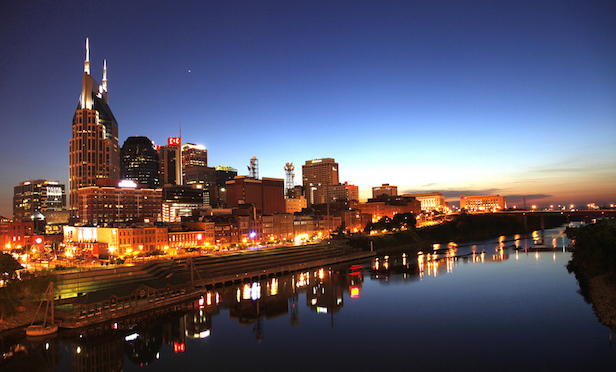
LOS ANGELES—Third-quarter office vacancies nationwide remained at their lowest rate since 2008, holding steady at 13.1%, CBRE Group said Monday. In line with a recent pattern, the suburbs outperformed CBDs, and CBRE also cites faster growth in mid-sized markets, such as Nashville, which currently boasts the nation's lowest vacancy rate at 5.5%.
While vacancies fells 10 basis points to 14.3% in suburban office markets during Q3, CBD vacancies rose 20 bps to 10.7% in the same time period. “Despite their rumored demise, the suburbs continue to perform soundly,” says Jeffrey Havsy, Americas chief economist for CBRE.
He adds that this is especially true of “those locations that offer a live-work-play dynamic and have good transportation access. The suburbs have been painted with a negative brushstroke, but that labeling masks the diversity among the various submarkets. Those locations that offer appropriate amenities, have good access and offer modern facilities continue to lease well.”
A majority of US markets saw improved conditions during Q3 2016, with vacancy declining in 37 of 63 office markets, rising in 22, and remaining unchanged in four. The biggest vacancy declines seen during Q3 were in Tucson (170 bps), Cincinnati (130 bps) and Raleigh (120 bps). West Palm Beach, Newark, Las Vegas, Albany, Riverside and Sacramento each declined by 90 bps or more.
Q3 also saw a continuation of a yearlong trend that has mid-sized markets performing best. Compared with Q3 2015, Tucson, St. Louis, Raleigh, Riverside, Oakland, Sacramento, Cincinnati and Tampa all have experienced the sharpest declines in vacancy.
Along with Nashville, San Francisco was the only office market to post vacancies of less than 7.5% in Q3, coming in at 6.7%. Other low-vacancy markets included Raleigh with 8%, Austin (8.1%), Seattle (8.6%), Oakland (8.7%), San Jose (8.9%) and Pittsburgh (9.2%).
In its Q3 report on the office sector, issued last week, Cushman & Wakefield noted that net absorption outpaced new construction, but it's occurring at a slower pace, in keeping with the more moderate pace of job growth. Net absorption of office space totaled 13.2 million square feet during the quarter, compared to 17.9 million square feet in Q2. In the first three quarters of this year, the amount of space absorbed totaled 42.2 million square feet, more than 31% lower than the year-ago period.
LOS ANGELES—Third-quarter office vacancies nationwide remained at their lowest rate since 2008, holding steady at 13.1%, CBRE Group said Monday. In line with a recent pattern, the suburbs outperformed CBDs, and CBRE also cites faster growth in mid-sized markets, such as Nashville, which currently boasts the nation's lowest vacancy rate at 5.5%.
While vacancies fells 10 basis points to 14.3% in suburban office markets during Q3, CBD vacancies rose 20 bps to 10.7% in the same time period. “Despite their rumored demise, the suburbs continue to perform soundly,” says Jeffrey Havsy, Americas chief economist for CBRE.
He adds that this is especially true of “those locations that offer a live-work-play dynamic and have good transportation access. The suburbs have been painted with a negative brushstroke, but that labeling masks the diversity among the various submarkets. Those locations that offer appropriate amenities, have good access and offer modern facilities continue to lease well.”
A majority of US markets saw improved conditions during Q3 2016, with vacancy declining in 37 of 63 office markets, rising in 22, and remaining unchanged in four. The biggest vacancy declines seen during Q3 were in Tucson (170 bps), Cincinnati (130 bps) and Raleigh (120 bps). West Palm Beach, Newark, Las Vegas, Albany, Riverside and Sacramento each declined by 90 bps or more.
Q3 also saw a continuation of a yearlong trend that has mid-sized markets performing best. Compared with Q3 2015, Tucson, St. Louis, Raleigh, Riverside, Oakland, Sacramento, Cincinnati and Tampa all have experienced the sharpest declines in vacancy.
Along with Nashville, San Francisco was the only office market to post vacancies of less than 7.5% in Q3, coming in at 6.7%. Other low-vacancy markets included Raleigh with 8%, Austin (8.1%), Seattle (8.6%), Oakland (8.7%), San Jose (8.9%) and Pittsburgh (9.2%).
In its Q3 report on the office sector, issued last week, Cushman & Wakefield noted that net absorption outpaced new construction, but it's occurring at a slower pace, in keeping with the more moderate pace of job growth. Net absorption of office space totaled 13.2 million square feet during the quarter, compared to 17.9 million square feet in Q2. In the first three quarters of this year, the amount of space absorbed totaled 42.2 million square feet, more than 31% lower than the year-ago period.
© Arc, All Rights Reserved. Request academic re-use from www.copyright.com. All other uses, submit a request to TMSalesOperations@arc-network.com. For more information visit Asset & Logo Licensing.