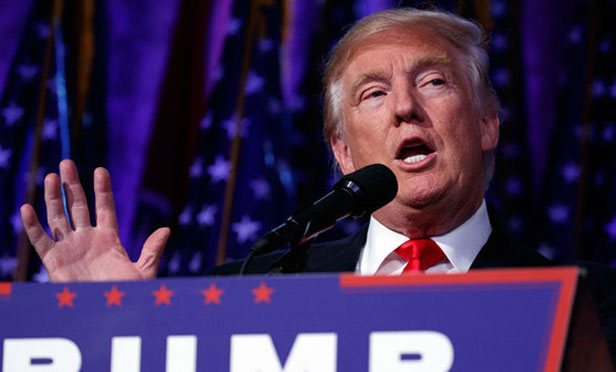
The market reaction was dramatic and swift when it became apparent early Wednesday morning that Donald Trump had been elected the 45th president of the US. But once trading in the US got underway, the S&P 500, which had plummeted as much as 7.5% in the futures market overnight, was up slightly; gold, which had soared, was little changed; and the dollar recovered from earlier losses. What didn't rebound was the U.S. Treasury market, according to an article written by GlobeSt.com sister publication, ALM's Think Advisor.
The yield on the 10-year Treasury note surged to 2.06% by midday Wednesday, up 20 basis points from the previous close, suggesting that Tuesday's Republican sweep of the White House, Senate and House of Representatives could result in higher inflation and a much larger budget deficit due to increased government spending increased coupled with large tax cuts. Then a $23 billion auction of 10-year Treasury notes was met with weak demand – the weakest since March 2009, according to Reuters.
Trump has proposed a massive infrastructure spending – double that of Hillary Clinton's proposed $275-billion plan, but with few details provided thus far – as well as tax cuts for corporations and individuals, especially higher earners, a bigger standard tax deduction and some additional tax credits. The net result over the next decade, according to the conservative Tax Foundation, would be a federal deficit that is $2.6 trillion to $3.9 trillion larger.
David Kelly, chief global strategist at JPMorgan Funds, said, “Actual policy changes may be far less dramatic than was proposed by Mr. Trump during the campaign” because “'establishment' Republicans … may well balk at unfunded tax cuts or spending increases [and] both the new President and Congress will likely act more slowly on dismantling the Affordable Care Act or trade agreements, until some better alternatives can be found.”
Carl Weinberg, chief economist at High Frequency Economics, noted in his commentary that “no one knows yet what is coming and when, or even if it is coming at all,” referring to U.S. tax, trade, immigration and health care policy.
Click here to continue reading the full article at Think Advisor.
The market reaction was dramatic and swift when it became apparent early Wednesday morning that Donald Trump had been elected the 45th president of the US. But once trading in the US got underway, the S&P 500, which had plummeted as much as 7.5% in the futures market overnight, was up slightly; gold, which had soared, was little changed; and the dollar recovered from earlier losses. What didn't rebound was the U.S. Treasury market, according to an article written by GlobeSt.com sister publication, ALM's Think Advisor.
The yield on the 10-year Treasury note surged to 2.06% by midday Wednesday, up 20 basis points from the previous close, suggesting that Tuesday's Republican sweep of the White House, Senate and House of Representatives could result in higher inflation and a much larger budget deficit due to increased government spending increased coupled with large tax cuts. Then a $23 billion auction of 10-year Treasury notes was met with weak demand – the weakest since March 2009, according to Reuters.
Trump has proposed a massive infrastructure spending – double that of Hillary Clinton's proposed $275-billion plan, but with few details provided thus far – as well as tax cuts for corporations and individuals, especially higher earners, a bigger standard tax deduction and some additional tax credits. The net result over the next decade, according to the conservative Tax Foundation, would be a federal deficit that is $2.6 trillion to $3.9 trillion larger.
David Kelly, chief global strategist at JPMorgan Funds, said, “Actual policy changes may be far less dramatic than was proposed by Mr. Trump during the campaign” because “'establishment' Republicans … may well balk at unfunded tax cuts or spending increases [and] both the new President and Congress will likely act more slowly on dismantling the Affordable Care Act or trade agreements, until some better alternatives can be found.”
Carl Weinberg, chief economist at High Frequency Economics, noted in his commentary that “no one knows yet what is coming and when, or even if it is coming at all,” referring to U.S. tax, trade, immigration and health care policy.
Click here to continue reading the full article at Think Advisor.
© Arc, All Rights Reserved. Request academic re-use from www.copyright.com. All other uses, submit a request to TMSalesOperations@arc-network.com. For more information visit Asset & Logo Licensing.