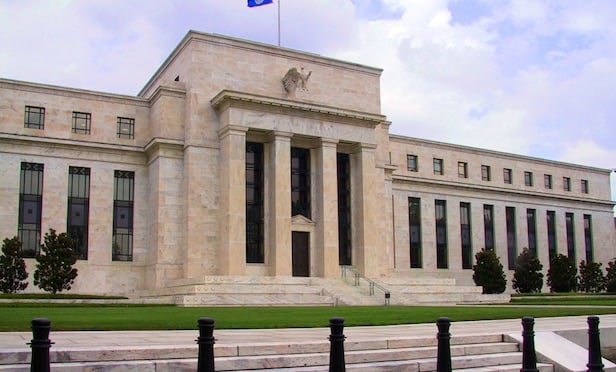
 Federal Reserve headquarters in Washington, DC.
LOS ANGELES—The capital markets outlook is expected to remain “favorable” in the near term, despite what CBRE sees as evidence of “some cooling” in the environment. Among other indicators, the pace of growth in lending has moderated over the past year, according to the Mortgage Bankers Association's latest Commercial/Multifamily Mortgage Bankers Originations Index. It rose by 7.1% between the second quarter and Q3, yet the year-over-year increase was a comparatively modest 4.6%.
Although the FDIC hasn't released Q3 data yet, CBRE's US Capital Markets Q3 2016 report cites “early signs that bank lending may be subsiding.” The firm cites its own research that bank originations began to ease last quarter, while the Federal Reserve's latest Senior Loan Officer Opinion Survey on Bank Lending Practices shows that although demand for commercial real estate loans is still up, “the level is much lower than in previous quarters.”
Then there's the “ample evidence” of difficulty in obtaining construction financing, notwithstanding the $19.2-billion increase in non-residential construction and land development loans held by banks in the first half of this year. CBRE's report notes that the Fed survey reveals “significant tightening in construction loans, as well as loans for existing real estate assets. For construction loans, 31.4% net percentage of loan officers reported tighter standards in the three months leading up to the survey.” That's a considerable jump from the year-ago period, when 1.4% of loan officers reported tightening.
After banks and the GSEs, the third largest source of debt capital is CMBS, which “got back on track somewhat” in Q3, with new issuance increasing by more than half to $19 billion from Q2's $11 billion. CBRE credited improved pricing with the increase.
“Despite the improvement, issuance for the year is expected to lag last year's total of more than $100 billion by a considerable margin,” according to CBRE. “Year-to-date issuance through Q3 reached only $50 billion, compared with $78 billion last year.”
Next month brings new risk-retention requirements to CMBS issuers, effective Dec. 24. “As a result, issuers need to meet the new requirements now, due to the time lag between closing loans and issuing securities,” te report states. Some issuers will also need to identify eligible capital sources and partners to complete securities purchases that conform to the new requirements.
CBRE notes that the first CMBS deal to meet risk-retention requirements received a positive response when it came to market this past August. “While this is a promising sign, there are concerns that available issuance capacity may be constrained in the short term, as issuers alter their business platforms to meet the requirements,” according to CBRE.
Along with the aforementioned quarterly survey from the Fed, CBRE sees other indicators that lending standards may be tightening, “although the picture is not totally transparent.” While most of the underwriting criteria in the firm's separate Q3 US Lending MarketView report point in this direction, CBRE notes that loan-to-value ratios were mixed during the quarter. Multifamily LTVs declined, while commercial LTVs increased, rising slightly from an average of 59.5% in Q2 to 60.2 in Q3. “The gradual rise over the past two quarters reflects a recovery in commercial real estate debt availability and more CMBS loan closings,” according to CBRE.
Federal Reserve headquarters in Washington, DC.
LOS ANGELES—The capital markets outlook is expected to remain “favorable” in the near term, despite what CBRE sees as evidence of “some cooling” in the environment. Among other indicators, the pace of growth in lending has moderated over the past year, according to the Mortgage Bankers Association's latest Commercial/Multifamily Mortgage Bankers Originations Index. It rose by 7.1% between the second quarter and Q3, yet the year-over-year increase was a comparatively modest 4.6%.
Although the FDIC hasn't released Q3 data yet, CBRE's US Capital Markets Q3 2016 report cites “early signs that bank lending may be subsiding.” The firm cites its own research that bank originations began to ease last quarter, while the Federal Reserve's latest Senior Loan Officer Opinion Survey on Bank Lending Practices shows that although demand for commercial real estate loans is still up, “the level is much lower than in previous quarters.”
Then there's the “ample evidence” of difficulty in obtaining construction financing, notwithstanding the $19.2-billion increase in non-residential construction and land development loans held by banks in the first half of this year. CBRE's report notes that the Fed survey reveals “significant tightening in construction loans, as well as loans for existing real estate assets. For construction loans, 31.4% net percentage of loan officers reported tighter standards in the three months leading up to the survey.” That's a considerable jump from the year-ago period, when 1.4% of loan officers reported tightening.
After banks and the GSEs, the third largest source of debt capital is CMBS, which “got back on track somewhat” in Q3, with new issuance increasing by more than half to $19 billion from Q2's $11 billion. CBRE credited improved pricing with the increase.
“Despite the improvement, issuance for the year is expected to lag last year's total of more than $100 billion by a considerable margin,” according to CBRE. “Year-to-date issuance through Q3 reached only $50 billion, compared with $78 billion last year.”
Next month brings new risk-retention requirements to CMBS issuers, effective Dec. 24. “As a result, issuers need to meet the new requirements now, due to the time lag between closing loans and issuing securities,” te report states. Some issuers will also need to identify eligible capital sources and partners to complete securities purchases that conform to the new requirements.
CBRE notes that the first CMBS deal to meet risk-retention requirements received a positive response when it came to market this past August. “While this is a promising sign, there are concerns that available issuance capacity may be constrained in the short term, as issuers alter their business platforms to meet the requirements,” according to CBRE.
Along with the aforementioned quarterly survey from the Fed, CBRE sees other indicators that lending standards may be tightening, “although the picture is not totally transparent.” While most of the underwriting criteria in the firm's separate Q3 US Lending MarketView report point in this direction, CBRE notes that loan-to-value ratios were mixed during the quarter. Multifamily LTVs declined, while commercial LTVs increased, rising slightly from an average of 59.5% in Q2 to 60.2 in Q3. “The gradual rise over the past two quarters reflects a recovery in commercial real estate debt availability and more CMBS loan closings,” according to CBRE.
© Arc, All Rights Reserved. Request academic re-use from www.copyright.com. All other uses, submit a request to TMSalesOperations@arc-network.com. For more information visit Asset & Logo Licensing.