 SCOTTSDALE, AZ—In order to meet the needs and demands of the changing healthcare industry, real estate professionals need to adapt their strategies to new circumstances. “The delivery of care is and will continue to change.” That is according to Peter Trice, partner of the Innova Group.
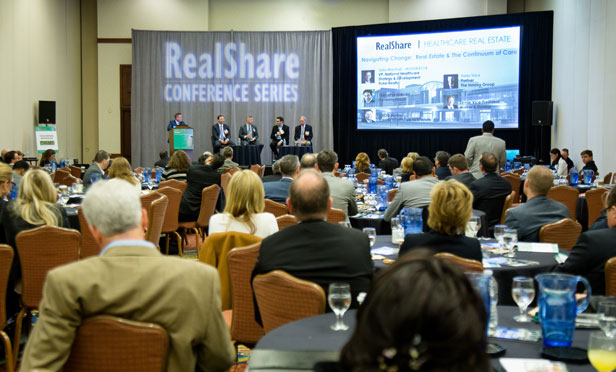
Trice recently spoke during the “Navigating Change: Real Estate and the Continuum of Care” panel at the RealShare Healthcare Real Estate on Thursday. When asked about looking at higher utilization within medical office buildings, Trice said that he is seeing health systems make a better utilization of their assets. For example, he pointed out that retail clinics are just one of many examples of how the healthcare system is meeting the needs of a population that needs access to healthcare outside of the 9 to 5 work day.
When moderator John Marshall, VP of national healthcare strategy and development at Duke Realty, asked panelists about key drivers for health systems navigating their level of care, Alain Beaini, executive director of Devenney Group, said that last year was about innovation. But today, he said, it is about running faster.
In addition, Beaini said that flexibility is a very complicated thing, but he said that there always has to be flexibility in design. “There is not a one size fits all.”
As for the continued development of medical office buildings versus the continued escalation of skilled nursing, Jason Signor, CEO and partner of Caddis Healthcare Real Estate, said that one thing he expects to see going forward is an increased emphasis on efficiency. “In everything we are doing in healthcare, we are trying to eliminate any fat or excess in what we are doing.”
And it is important to learn what the needs are to create new efficiency, whether it is lowering cost to capital or working with designers who have an acute awareness of finding efficiencies for other clients, said Signor. The other thing that is happening, he said, is that you are seeing more single-tenant buildings. And the third big trend he pointed to is a decline in new development of MOB year over year.
Signor also expects to see more development for end of life care. “We are putting more of our emphasis on post acute development because we think there is an emphasis on lowering the cost of care, so being more efficient there will be key.”
Michael Vaughn, SVP of Walker & Dunlop, said that seniors housing has been a continuum of its own. “I haven't seen very much where the seniors housing continuum is linked up with the ambulatory care facilities…it is usually through the discharge process from the hospitals.
When looking at repositioning existing assets, Signor said that the number of times he has looked, in most cases, it wasn't cost effective. “Whether it isn't located properly, doesn't have parking, or the utility services are different, we have had a struggle figuring out how to make it work.
Beaini agreed that it isn't simple to upgrade an old hotel or warehouse into a rehab facility. “We have been part of those deals but they are challenging and expensive and they have usually been done because of the specific location.” Vaughn agreed that while some of them work, it is usually better if you purpose build.
SCOTTSDALE, AZ—In order to meet the needs and demands of the changing healthcare industry, real estate professionals need to adapt their strategies to new circumstances. “The delivery of care is and will continue to change.” That is according to Peter Trice, partner of the Innova Group.
Trice recently spoke during the “Navigating Change: Real Estate and the Continuum of Care” panel at the RealShare Healthcare Real Estate on Thursday. When asked about looking at higher utilization within medical office buildings, Trice said that he is seeing health systems make a better utilization of their assets. For example, he pointed out that retail clinics are just one of many examples of how the healthcare system is meeting the needs of a population that needs access to healthcare outside of the 9 to 5 work day.
When moderator John Marshall, VP of national healthcare strategy and development at Duke Realty, asked panelists about key drivers for health systems navigating their level of care, Alain Beaini, executive director of Devenney Group, said that last year was about innovation. But today, he said, it is about running faster.
In addition, Beaini said that flexibility is a very complicated thing, but he said that there always has to be flexibility in design. “There is not a one size fits all.”
As for the continued development of medical office buildings versus the continued escalation of skilled nursing, Jason Signor, CEO and partner of Caddis Healthcare Real Estate, said that one thing he expects to see going forward is an increased emphasis on efficiency. “In everything we are doing in healthcare, we are trying to eliminate any fat or excess in what we are doing.”
And it is important to learn what the needs are to create new efficiency, whether it is lowering cost to capital or working with designers who have an acute awareness of finding efficiencies for other clients, said Signor. The other thing that is happening, he said, is that you are seeing more single-tenant buildings. And the third big trend he pointed to is a decline in new development of MOB year over year.
Signor also expects to see more development for end of life care. “We are putting more of our emphasis on post acute development because we think there is an emphasis on lowering the cost of care, so being more efficient there will be key.”
Michael Vaughn, SVP of Walker & Dunlop, said that seniors housing has been a continuum of its own. “I haven't seen very much where the seniors housing continuum is linked up with the ambulatory care facilities…it is usually through the discharge process from the hospitals.
When looking at repositioning existing assets, Signor said that the number of times he has looked, in most cases, it wasn't cost effective. “Whether it isn't located properly, doesn't have parking, or the utility services are different, we have had a struggle figuring out how to make it work.
Beaini agreed that it isn't simple to upgrade an old hotel or warehouse into a rehab facility. “We have been part of those deals but they are challenging and expensive and they have usually been done because of the specific location.” Vaughn agreed that while some of them work, it is usually better if you purpose build.
© Arc, All Rights Reserved. Request academic re-use from www.copyright.com. All other uses, submit a request to TMSalesOperations@arc-network.com. For more information visit Asset & Logo Licensing.