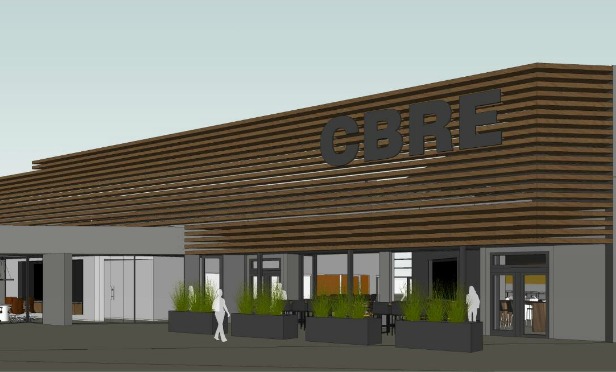
LOS ANGELES—CBRE is expanding its Workplace 360 office concept, and its focusing on alternative commercial properties for office space. Last year, CBRE moved into a former Masonic Temple in Glendale, and now, the firm is leasing a former restaurant in Woodland Hills and a former retail space in Oxnard. To find out more about the employee response to the Workplace 360 strategy and why these alternative spaces are making the perfect home for the concept, we sat down with David Josker, managing director of the L.A. North market at CBRE, for an exclusive interview.
GlobeSt.com: Why have alternative spaces been appealing for the CBRE-style workplace?
David Josker: As the world leader in real estate we understand that people will scrutinize how we utilize our workspace. CBRE is always looking to differentiate itself, to showcase our out-of-the-box thinking to our clients and peers and to present our identity through the buildings we occupy. The combination of structural elegance and high-tech design and functionality at our new workplace strategy offices such as in Woodland Hills are phenomenal calling cards for our company. The uniqueness of our spaces help create a world-class work environment for our professionals to collaborate be mobile to serve the needs of our clients.
GlobeSt.com: What is the vision for this new office space?
Josker: This space will be phenomenal. We are incorporating our address-free and paperless concept as we have done at such offices as our Downtown LA headquarters, at the Masonic Temple in Glendale and now in Oxnard, our latest Workplace360 office in this region, which just opened last week. Since we're converting a former restaurant space in Woodland Hills, we've come up with some creative components we'll be implementing. The office will feature retractable glass doors facing the patio, which will provide the opportunity to work inside or outside as it overlooks the adjacent park and will make for a one-of-a-kind working environment. We will also incorporate the CBRE concierge program, similarly to what we've done in Glendale. It's a service offered to our professionals where our concierge handle such chores as dry cleaning, washing your car, filling it up with gas or shopping for your groceries. We are always looking for ways to give back time to our professionals.
GlobeSt.com: It has been a few years now since you rolled out these open workspaces. What has the response been like from employees?
Josker: Our professionals love it! At first there was some apprehension, and now internal surveys show that more than 90 percent of employees in these Workplace360 offices wouldn't go back to the old way of working. With these types of spaces we are making it crystal clear that our professionals come first. We are saying loud and clear “We are investing in our most important asset – people.”
GlobeSt.com: How have these spaces evolved since 2013? How is each space different?
Josker: It's been a true evolution. In Downtown we introduced the paperless and address-free concept in a revamped former law library at the top of an office tower. The Masonic Temple was the company's first adaptive reuse, taking a building that was grossly underused and converting it into a modern progressive workspace, we also added the concierge service component. In Woodland Hills and in Oxnard we're taking the idea of transforming spaces that were intended for a completely different use, in Woodland Hills a restaurant and in Oxnard a retail space, into state-of-the-art offices. Each time we're pushing the envelope and the concept of space and technology use a bit further. It helps us as company to stay agile and on our toes, and it also gives us the credibility with our clients that we can tackle any project with creativity and skill.
LOS ANGELES—CBRE is expanding its Workplace 360 office concept, and its focusing on alternative commercial properties for office space. Last year, CBRE moved into a former Masonic Temple in Glendale, and now, the firm is leasing a former restaurant in Woodland Hills and a former retail space in Oxnard. To find out more about the employee response to the Workplace 360 strategy and why these alternative spaces are making the perfect home for the concept, we sat down with David Josker, managing director of the L.A. North market at CBRE, for an exclusive interview.
GlobeSt.com: Why have alternative spaces been appealing for the CBRE-style workplace?
David Josker: As the world leader in real estate we understand that people will scrutinize how we utilize our workspace. CBRE is always looking to differentiate itself, to showcase our out-of-the-box thinking to our clients and peers and to present our identity through the buildings we occupy. The combination of structural elegance and high-tech design and functionality at our new workplace strategy offices such as in Woodland Hills are phenomenal calling cards for our company. The uniqueness of our spaces help create a world-class work environment for our professionals to collaborate be mobile to serve the needs of our clients.
GlobeSt.com: What is the vision for this new office space?
Josker: This space will be phenomenal. We are incorporating our address-free and paperless concept as we have done at such offices as our Downtown LA headquarters, at the Masonic Temple in Glendale and now in Oxnard, our latest Workplace360 office in this region, which just opened last week. Since we're converting a former restaurant space in Woodland Hills, we've come up with some creative components we'll be implementing. The office will feature retractable glass doors facing the patio, which will provide the opportunity to work inside or outside as it overlooks the adjacent park and will make for a one-of-a-kind working environment. We will also incorporate the CBRE concierge program, similarly to what we've done in Glendale. It's a service offered to our professionals where our concierge handle such chores as dry cleaning, washing your car, filling it up with gas or shopping for your groceries. We are always looking for ways to give back time to our professionals.
GlobeSt.com: It has been a few years now since you rolled out these open workspaces. What has the response been like from employees?
Josker: Our professionals love it! At first there was some apprehension, and now internal surveys show that more than 90 percent of employees in these Workplace360 offices wouldn't go back to the old way of working. With these types of spaces we are making it crystal clear that our professionals come first. We are saying loud and clear “We are investing in our most important asset – people.”
GlobeSt.com: How have these spaces evolved since 2013? How is each space different?
Josker: It's been a true evolution. In Downtown we introduced the paperless and address-free concept in a revamped former law library at the top of an office tower. The Masonic Temple was the company's first adaptive reuse, taking a building that was grossly underused and converting it into a modern progressive workspace, we also added the concierge service component. In Woodland Hills and in Oxnard we're taking the idea of transforming spaces that were intended for a completely different use, in Woodland Hills a restaurant and in Oxnard a retail space, into state-of-the-art offices. Each time we're pushing the envelope and the concept of space and technology use a bit further. It helps us as company to stay agile and on our toes, and it also gives us the credibility with our clients that we can tackle any project with creativity and skill.
© Arc, All Rights Reserved. Request academic re-use from www.copyright.com. All other uses, submit a request to TMSalesOperations@arc-network.com. For more information visit Asset & Logo Licensing.