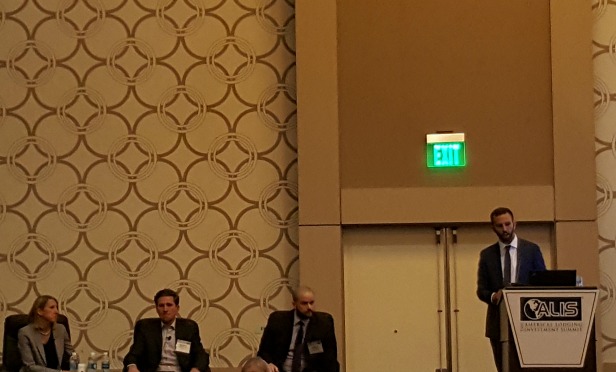
LOS ANGELES—Peer-to-peer accommodations platform Airbnb isn't capturing the business travel segment, according to an Airbnb-focused panel discussion at ALIS last week. The majority of the website's users are leisure travelers, and nearly 50% of those travelers are staying longer than six days. This was one area where hoteliers were not concerned by the Airbnb effect.
That doesn't mean that Airbnb isn't working to capture the business travel segment. Panel moderator Jamie Lane, senior economist at CBRE Hotels Research shared data from a survey conducted by Morgan Stanley showing that business travelers increased by 18% in 2016, and this year, the study estimated that Airbnb would increase its business traveler users by 23%. Those are huge numbers considering that the platform increased its leisure traveler users by 19% in 2016 and is expected to increase its leisure traveler users by 25% in 2017—nearly on par with the growth in its business traveler numbers. “They are growing in the business travel segment, but not as fast as leisure,” said Candace C. Johnson, VP of performance optimization at Two Roads Hospitality about the numbers. Brenna Halliday, VP of Strategic Analysis at Host Hotels & Resorts, added that the Airbnb platform really grew in 2013 and since then has accounted for 4.5% of total hotel revenue.
In addition to growing its business platform, Lane also said the Morgan Stanley study revealed that Airbnb is gaining more and more market share away from hotels. In 2016, Airbnb grew its total unit numbers by 70.2% and its total supply by 117.0% year-over-year. Revenue from 2015 to 2016 grew 147.8% and demand 121.5%.
These numbers aren't new travelers, either. Another graph from that Morgan Stanley study showed that 49% of Airbnb users in 2016 would have otherwise stayed in a traditional hotel had Airbnb not been an option, compared to 41% who made the same claim in 2015. The platform impacted traditional hotels the most. The study showed that only 37% of Airbnb users who would have stayed in a bed and breakfast, 35% with friends and family and 26% in an extended stay hotel.
Although these numbers are expected to climb even higher this year, hoteliers on the panel said that concerns about the Airbnb supply were overstated.
LOS ANGELES—Peer-to-peer accommodations platform Airbnb isn't capturing the business travel segment, according to an Airbnb-focused panel discussion at ALIS last week. The majority of the website's users are leisure travelers, and nearly 50% of those travelers are staying longer than six days. This was one area where hoteliers were not concerned by the Airbnb effect.
That doesn't mean that Airbnb isn't working to capture the business travel segment. Panel moderator Jamie Lane, senior economist at CBRE Hotels Research shared data from a survey conducted by
In addition to growing its business platform, Lane also said the
These numbers aren't new travelers, either. Another graph from that
Although these numbers are expected to climb even higher this year, hoteliers on the panel said that concerns about the Airbnb supply were overstated.
© Arc, All Rights Reserved. Request academic re-use from www.copyright.com. All other uses, submit a request to TMSalesOperations@arc-network.com. For more information visit Asset & Logo Licensing.