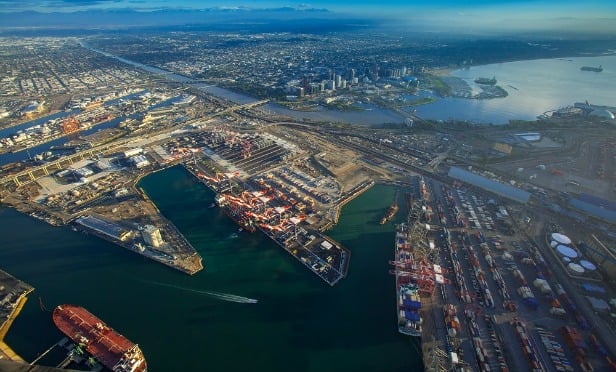
LOS ANGELES—It's no secret. The Port of Long Beach had more than a few obstacles in 2016, including the Hanjin Bankruptcy that caused a major slowdown at the port and a change in leadership after CEO Jon Slangerup stepped down. Additionally, 2015 was a record-breaking year for the port, making it a challenge for 2016 to produce year-over-year gains. Despite the challenges, 2016 was still the fifth best year in the port's history. Looking ahead, the port has a positive outlook for 2017 and remains committed to sustainability.
“The challenges of 2016 were tough for many in the industry,” Lee Peterson of the Port of Long Beach, tells GlobeSt.com. “The unfortunate bankruptcy of Hanjin saw the end of a longtime partnership between the Port and Hanjin. Of course our cargo flows did decline, but we expect that that cargo will return to Long Beach this year. Our CEO moved on, but we had Duane Kenagy to immediately step in as interim CEO, and we had the continuity of the Harbor Commission to lead the Port as well.”
Although the Port of Long Beach expects an improvement over 2016 numbers, it may not beat the tremendous cargo volumes in 2015. “For containerized cargo, we expect modest improvement in 2017 compared to 2016,” says Peterson. “We will have more activity at Pier T in particular, as the new lease agreement expands MSC's role and brings in Hyundai Merchant Marine. We expect continued growth at the Pier E terminal operated by LBCT. We expect 2017 to be a productive year for the Port in many ways as we carry on with our capital programs, environmental improvement and community outreach.”
This year, the port will continue to make significant investments to improve infrastructure and make strides toward sustainability and a green future. “At the present time, we are working on the Clean Air Action Plan version 3.0, an update of the San Pedro Bay Ports CAAP originally adopted in 2006,” says Peterson. “We are working together with our neighbor, the Port of Los Angeles, to finalize the CAAP and present it for approval before a joint meeting of the two Harbor Commissions, probably in the spring. This CAAP will continue our efforts to keep pushing for a zero-emissions port.” Interim CEO Duane Kenagy says that the port is well capitalized to continue to make these improvements, which will result in a more competitive port internationally.
LOS ANGELES—It's no secret. The Port of Long Beach had more than a few obstacles in 2016, including the Hanjin Bankruptcy that caused a major slowdown at the port and a change in leadership after CEO Jon Slangerup stepped down. Additionally, 2015 was a record-breaking year for the port, making it a challenge for 2016 to produce year-over-year gains. Despite the challenges, 2016 was still the fifth best year in the port's history. Looking ahead, the port has a positive outlook for 2017 and remains committed to sustainability.
“The challenges of 2016 were tough for many in the industry,” Lee Peterson of the Port of Long Beach, tells GlobeSt.com. “The unfortunate bankruptcy of Hanjin saw the end of a longtime partnership between the Port and Hanjin. Of course our cargo flows did decline, but we expect that that cargo will return to Long Beach this year. Our CEO moved on, but we had Duane Kenagy to immediately step in as interim CEO, and we had the continuity of the Harbor Commission to lead the Port as well.”
Although the Port of Long Beach expects an improvement over 2016 numbers, it may not beat the tremendous cargo volumes in 2015. “For containerized cargo, we expect modest improvement in 2017 compared to 2016,” says Peterson. “We will have more activity at Pier T in particular, as the new lease agreement expands MSC's role and brings in Hyundai Merchant Marine. We expect continued growth at the Pier E terminal operated by LBCT. We expect 2017 to be a productive year for the Port in many ways as we carry on with our capital programs, environmental improvement and community outreach.”
This year, the port will continue to make significant investments to improve infrastructure and make strides toward sustainability and a green future. “At the present time, we are working on the Clean Air Action Plan version 3.0, an update of the San Pedro Bay Ports CAAP originally adopted in 2006,” says Peterson. “We are working together with our neighbor, the Port of Los Angeles, to finalize the CAAP and present it for approval before a joint meeting of the two Harbor Commissions, probably in the spring. This CAAP will continue our efforts to keep pushing for a zero-emissions port.” Interim CEO Duane Kenagy says that the port is well capitalized to continue to make these improvements, which will result in a more competitive port internationally.
© Arc, All Rights Reserved. Request academic re-use from www.copyright.com. All other uses, submit a request to TMSalesOperations@arc-network.com. For more information visit Asset & Logo Licensing.