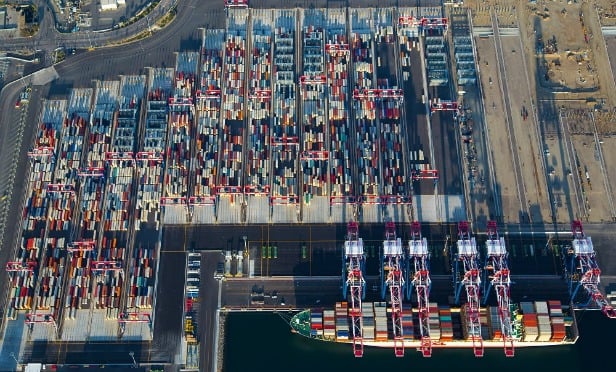
LOS ANGELES—The Port of Long Beach is starting off 2017 with a bang after a downtrodden end to 2016. In the month of January, the port reported an 8.7% increase in cargo volumes compared to January 2016. The year-over-year increase was significant, considering that January 2016 saw a 25% year-over-year increase in cargo volumes.
“We saw activity rise in January in part to the increase in activity at our Pier T, thanks to additional ships from MSC,” Lee Peterson of the Port of Long Beach, tells GlobeSt.com. “The terminal at Pier T, our biggest, was never closed due to the Hanjin bankruptcy, but the flow of cargo did slow down at the end of 2016. We're likely seeing that turnaround now. Also, the start of Chinese New Year on Jan. 28 convinced many shippers to transport their goods before the holiday. They prefer to bring through more cargo before the new year festival, which can see the closure of some industries for one-to-two weeks.”
The port moved a total of 582,689 twenty-foot equivalent units during the month, with exports alone jumping 10.8% year-over-year to 118,234 containers. Imports increased 7.4% to 298,990 TEUs, while empties sent back to the Far East rose 9.6% to 165,465.
The Port of Long Beach wasn't the only port to see a boost in cargo volumes. “In reality, the San Pedro Bay ports combined overall saw an increase in cargo in 2016 compared to 2015, up almost 2%, says Peterson. “The difficulty for us was the Hanjin bankruptcy, and seeing the cargo flow going to our neighbor. Eventually, that cargo may return to our Port, through one shipping line or another. We expect modest gains overall in 2017.”
Lee has already said that they expect a nominal increase in cargo volumes this year as the port continues its modernization and sustainability efforts.
LOS ANGELES—The Port of Long Beach is starting off 2017 with a bang after a downtrodden end to 2016. In the month of January, the port reported an 8.7% increase in cargo volumes compared to January 2016. The year-over-year increase was significant, considering that January 2016 saw a 25% year-over-year increase in cargo volumes.
“We saw activity rise in January in part to the increase in activity at our Pier T, thanks to additional ships from MSC,” Lee Peterson of the Port of Long Beach, tells GlobeSt.com. “The terminal at Pier T, our biggest, was never closed due to the Hanjin bankruptcy, but the flow of cargo did slow down at the end of 2016. We're likely seeing that turnaround now. Also, the start of Chinese New Year on Jan. 28 convinced many shippers to transport their goods before the holiday. They prefer to bring through more cargo before the new year festival, which can see the closure of some industries for one-to-two weeks.”
The port moved a total of 582,689 twenty-foot equivalent units during the month, with exports alone jumping 10.8% year-over-year to 118,234 containers. Imports increased 7.4% to 298,990 TEUs, while empties sent back to the Far East rose 9.6% to 165,465.
The Port of Long Beach wasn't the only port to see a boost in cargo volumes. “In reality, the San Pedro Bay ports combined overall saw an increase in cargo in 2016 compared to 2015, up almost 2%, says Peterson. “The difficulty for us was the Hanjin bankruptcy, and seeing the cargo flow going to our neighbor. Eventually, that cargo may return to our Port, through one shipping line or another. We expect modest gains overall in 2017.”
Lee has already said that they expect a nominal increase in cargo volumes this year as the port continues its modernization and sustainability efforts.
© Arc, All Rights Reserved. Request academic re-use from www.copyright.com. All other uses, submit a request to TMSalesOperations@arc-network.com. For more information visit Asset & Logo Licensing.