WASHINGTON, DC–Fannie Mae hit a number of high notes last year with its multifamily lending activities. It provided $55.3 billion through its Delegated Underwriting and Servicing program — the highest volume since the program was established in 1988. That compares to $42.3 billion in 2015, a significant year over year increase.
It issued $54.9 billion worth of new issue mortgage-backed securities and attracted more than 100 new unique investors. (Since the program's inception there have been 200 investors in the program.) This translated into more than $10 billion in Guaranteed Multifamily Structures.
So how did it do all this? Simple, according to Fannie Mae executives.
The overall increase in DUS lending is due to the increase in demand for multifamily financing, Jonathan Gross, VP multifamily pricing and analytics, tells GlobeSt.com. “But of course, the point is we had the ability to respond to that demand,” through new products and investments in origination technology, such as its new DUS gateway application.
Fannie Mae has also been steadily broadening its product portfolio, even as the underlying parri passu execution has remained consistent, Hilary Provinse, senior vice president for Multifamily Customer Engagement tells GlobeSt.com. The most recent example is its recently-priced green CMBS tranches.
Provinse also attributes Fannie's record year to its approach to sustainability — which in this case does not refer to 'green' but rather longevity.
“Production is a big piece of leadership but we also look at sustainability because of loss sharing we have put in place,” she says. “We have brought credit leadership to the market.”
Fannie Mae has grown its purchaser base, every year adding new bond investors. “There has always been strong participation from money managers and over the years the numbers have increased,” Josh Seiff, VP of multifamily capital markets and trading, tells GlobeSt.com.
“This year, we have seen broader participation from the bank community. Banks traditionally are short duration players looking at two to five year securities. But now we are seeing banks interested in seven to ten years,” Seiff says.
The green CMBS tranche Fannie Mae priced recently also drew new investors, Seiff adds. “There were money managers and insurers who participated only because the two tranches were green — they wouldn't have participated otherwise.”
Last but not at all least, Fannie Mae points to its DUS lender participants as the key reason for its success. “This is a relationship-based business — you need reliable, trusting partners to get deals done for borrowers and meet the needs of the rental housing market,” Provinse says.
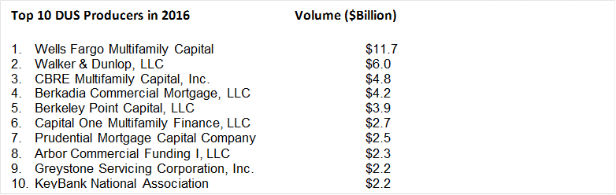
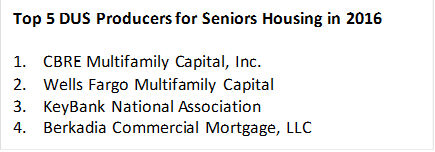
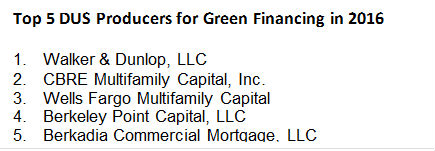
Fannie Mae broke down its $55.3 billion in 2016 production by the individual business categories [see charts at the end of the article] as well as the top lenders in each space. Overall, the top lenders were Wells Fargo Multifamily Capital, at $11.7 billion and Walker & Dunlop at $6 billion.
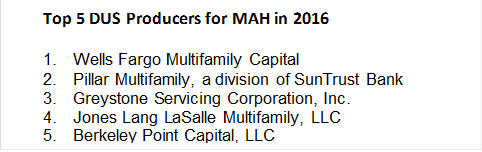
- In the affordable housing category overall production was $5.6 billion.
- Fannie Mae did $1.5 billion in senior housing last year compared to $2.7 billion in 2014.
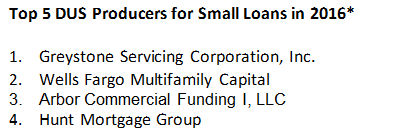
- Fannie Mae did $1.9 billion in small loans, an increase of 19% from $1.6 billion in 2015.
- Manufactured housing communities had $3 billion in transactions, an increase of 282% from $786 million in 2015.
- For student housing there were $2.5 billion in deals last year, an increase of 67% from $1.5 billion in 2015.
- There were $4.5 billion in structured transactions, an increase of 29% from $3.5 billion in 2015.
WASHINGTON, DC–Fannie Mae hit a number of high notes last year with its multifamily lending activities. It provided $55.3 billion through its Delegated Underwriting and Servicing program — the highest volume since the program was established in 1988. That compares to $42.3 billion in 2015, a significant year over year increase.
It issued $54.9 billion worth of new issue mortgage-backed securities and attracted more than 100 new unique investors. (Since the program's inception there have been 200 investors in the program.) This translated into more than $10 billion in Guaranteed Multifamily Structures.
So how did it do all this? Simple, according to
The overall increase in DUS lending is due to the increase in demand for multifamily financing, Jonathan Gross, VP multifamily pricing and analytics, tells GlobeSt.com. “But of course, the point is we had the ability to respond to that demand,” through new products and investments in origination technology, such as its new DUS gateway application.
Provinse also attributes Fannie's record year to its approach to sustainability — which in this case does not refer to 'green' but rather longevity.
“Production is a big piece of leadership but we also look at sustainability because of loss sharing we have put in place,” she says. “We have brought credit leadership to the market.”
“This year, we have seen broader participation from the bank community. Banks traditionally are short duration players looking at two to five year securities. But now we are seeing banks interested in seven to ten years,” Seiff says.
The green CMBS tranche
Last but not at all least,
- In the affordable housing category overall production was $5.6 billion.
- Manufactured housing communities had $3 billion in transactions, an increase of 282% from $786 million in 2015.
- For student housing there were $2.5 billion in deals last year, an increase of 67% from $1.5 billion in 2015.
- There were $4.5 billion in structured transactions, an increase of 29% from $3.5 billion in 2015.
© Arc, All Rights Reserved. Request academic re-use from www.copyright.com. All other uses, submit a request to TMSalesOperations@arc-network.com. For more information visit Asset & Logo Licensing.