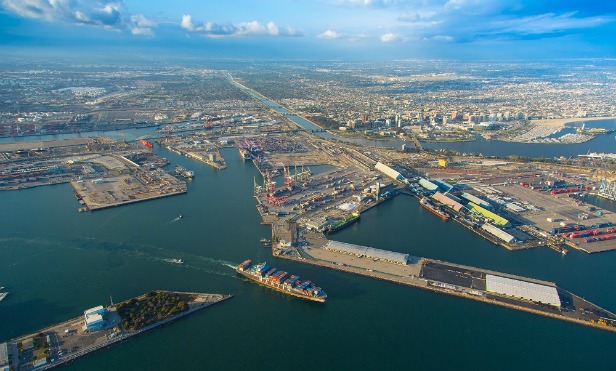
LOS ANGELES—The Port of Long Beach has secured a zero-emissions equipment grant to fund what will be one of the nation's largest demonstration projects for zero-emissions cargo handling equipment. The California Energy Commission awarded the port, which has been dedicated to sustainability through major improvements in the past several years, $9.7 million to design and create 25 new or converted electric cargo handling vehicles to be demonstrated for 12 months at Port of Long Beach terminals.
“This grant represents a significant leap forward on the path to zero emissions,” Renee Moilanen, Port of Long Beach Manager of Air Quality Practices, tells GlobeSt.com. “Not only will the grant fund cutting-edge zero-emissions equipment but it will also help us prove the viability of these technologies in a real-world port environment, and it will support workforce development programs to get our workers ready for a zero-emissions future. This grant will be critical in showing the goods movement industry that zero emissions is possible.” The total project will cost $13.7 million. Before the $9.7 million grant is officially rewarded, the Port will need approval from the Energy Commission.
The grant was difficult to secure, and was a competitive process. “We worked on pulling together the partners and developing the proposal for more than three months, knowing that we would be competing against all others ports and terminals in California,” explains Moilanen. “We worked with more than a dozen private and public partners to make sure we had the most competitive application, and ultimately, we had the highest scoring proposal.”
The project includes 9 rubber-tired gantry cranes, which have had the diesel motor removed to allow the crane to run on electricity. This will create the nation's largest deployment of fully electric rubber-tired gantry cranes,” says Moilanen. “These cranes are a big source of port equipment emissions. The grant also will pay for the purchase and testing of 12 battery-electric yard tractors and the conversion of 4 LNG trucks to plug-in hybrid electric that can operate in only zero-emissions mode near the ports.”
The project will reduce greenhouse gases by more than 1,323 tons and smog-causing nitrogen oxides by 27 tons, while the move to zero-emissions equipment is expected to save more than 270,000 gallons of diesel fuel.
LOS ANGELES—The Port of Long Beach has secured a zero-emissions equipment grant to fund what will be one of the nation's largest demonstration projects for zero-emissions cargo handling equipment. The California Energy Commission awarded the port, which has been dedicated to sustainability through major improvements in the past several years, $9.7 million to design and create 25 new or converted electric cargo handling vehicles to be demonstrated for 12 months at Port of Long Beach terminals.
“This grant represents a significant leap forward on the path to zero emissions,” Renee Moilanen, Port of Long Beach Manager of Air Quality Practices, tells GlobeSt.com. “Not only will the grant fund cutting-edge zero-emissions equipment but it will also help us prove the viability of these technologies in a real-world port environment, and it will support workforce development programs to get our workers ready for a zero-emissions future. This grant will be critical in showing the goods movement industry that zero emissions is possible.” The total project will cost $13.7 million. Before the $9.7 million grant is officially rewarded, the Port will need approval from the Energy Commission.
The grant was difficult to secure, and was a competitive process. “We worked on pulling together the partners and developing the proposal for more than three months, knowing that we would be competing against all others ports and terminals in California,” explains Moilanen. “We worked with more than a dozen private and public partners to make sure we had the most competitive application, and ultimately, we had the highest scoring proposal.”
The project includes 9 rubber-tired gantry cranes, which have had the diesel motor removed to allow the crane to run on electricity. This will create the nation's largest deployment of fully electric rubber-tired gantry cranes,” says Moilanen. “These cranes are a big source of port equipment emissions. The grant also will pay for the purchase and testing of 12 battery-electric yard tractors and the conversion of 4 LNG trucks to plug-in hybrid electric that can operate in only zero-emissions mode near the ports.”
The project will reduce greenhouse gases by more than 1,323 tons and smog-causing nitrogen oxides by 27 tons, while the move to zero-emissions equipment is expected to save more than 270,000 gallons of diesel fuel.
© Arc, All Rights Reserved. Request academic re-use from www.copyright.com. All other uses, submit a request to TMSalesOperations@arc-network.com. For more information visit Asset & Logo Licensing.