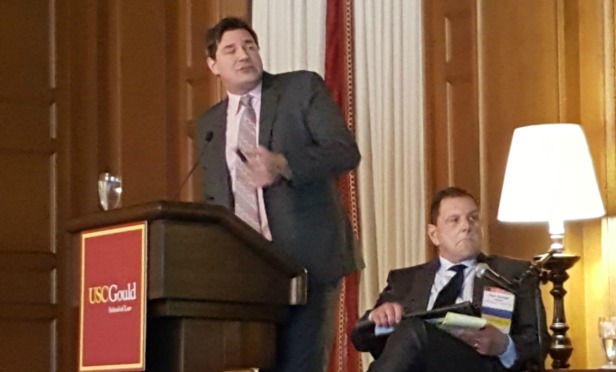
LOS ANGELES—California business growth will halt without densification. It was the not-so subtle argument that Christopher Thornberg, the founding partner of Beacon Economics, made as the opening speaker of the 2017 USC Gould Real Estate Law and Business Forum in Downtown Los Angeles. Thornberg's opening economic address took a thoughtful and positive look at the State of California and how to sustain growth. The answer: more housing.
“In the long run, growth is driven by population growth. It is as simple as that,” said Thornberg in his speech. “Ultimately, if you want more workforce growth, that boils down to having enough housing for that workforce to expand.”
While densification is necessary to the growth of a city, Thornberg said that it isn't happening here, and much of that has to do with regulations and community pushback. The city needs more housing, and it isn't building enough of it. “We do not build enough housing and that is something that is becoming worse and worse,” Thornberg said. “Relative to US trends, California is becoming really expensive.” The problem is intensifying as the population in California rapidly grows. Today, we add only one new housing permit for every four new people that move to this city, and while the multifamily market has bounced back, the single-family market has seen almost no growth since the recession.
In Los Angeles, the challenge of densification is an outdated general plan, which requires zoning changes for most new development projects. “We need to allow for overall densification,” said Thornberg. The original Los Angeles general plan was drafted in 1969 and allowed for 10 million people to live in Los Angeles. “We have constrained and regulated to stall housing development,” said Thornberg, adding that we should go back to that original plan.
According to Thornberg, the benefits to densification are vast. Dense cities have live-work-play environments, reduced traffic, slowed gentrification and the potential for open space. The only con he listed was less personal space and smaller living units. With all of the benefits of densification, Thornberg concluded: “If we don't move to a more density, we will constrain our ability to grow.”
LOS ANGELES—California business growth will halt without densification. It was the not-so subtle argument that Christopher Thornberg, the founding partner of Beacon Economics, made as the opening speaker of the 2017 USC Gould Real Estate Law and Business Forum in Downtown Los Angeles. Thornberg's opening economic address took a thoughtful and positive look at the State of California and how to sustain growth. The answer: more housing.
“In the long run, growth is driven by population growth. It is as simple as that,” said Thornberg in his speech. “Ultimately, if you want more workforce growth, that boils down to having enough housing for that workforce to expand.”
While densification is necessary to the growth of a city, Thornberg said that it isn't happening here, and much of that has to do with regulations and community pushback. The city needs more housing, and it isn't building enough of it. “We do not build enough housing and that is something that is becoming worse and worse,” Thornberg said. “Relative to US trends, California is becoming really expensive.” The problem is intensifying as the population in California rapidly grows. Today, we add only one new housing permit for every four new people that move to this city, and while the multifamily market has bounced back, the single-family market has seen almost no growth since the recession.
In Los Angeles, the challenge of densification is an outdated general plan, which requires zoning changes for most new development projects. “We need to allow for overall densification,” said Thornberg. The original Los Angeles general plan was drafted in 1969 and allowed for 10 million people to live in Los Angeles. “We have constrained and regulated to stall housing development,” said Thornberg, adding that we should go back to that original plan.
According to Thornberg, the benefits to densification are vast. Dense cities have live-work-play environments, reduced traffic, slowed gentrification and the potential for open space. The only con he listed was less personal space and smaller living units. With all of the benefits of densification, Thornberg concluded: “If we don't move to a more density, we will constrain our ability to grow.”
© Arc, All Rights Reserved. Request academic re-use from www.copyright.com. All other uses, submit a request to TMSalesOperations@arc-network.com. For more information visit Asset & Logo Licensing.