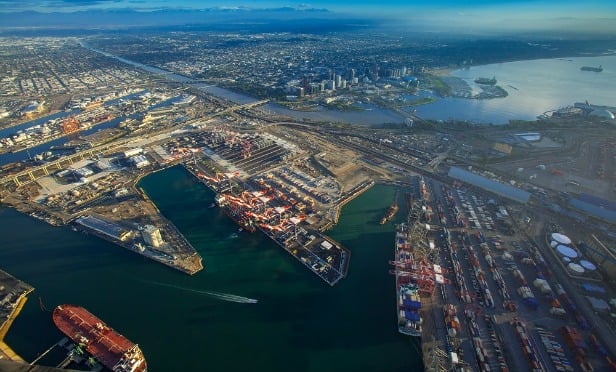
LOS ANGELES—The Port of Long Beach has approved guidelines for a $46 million plan to fund local health projects that will reduce environmental impacts. The program will specifically seek to bring health programs and new air filters to those most affected by the environmental impacts of the port. The $46 million is the most funding voluntarily committed by a US port authority and will be distributed over the next 12 to 15 years.
“Under our Green Port Policy, we are committed to protect the community from environmental impacts of Port operations and to promote sustainability,” Lee Peterson of the Port of Long Beach, tells GlobeSt.com. “The grants program is an excellent means to partner with the schools, clinics, health groups and others to find effective means to reducing the Port's impacts on the health of our neighbors. We always work aggressively to minimize emissions, noise and other byproducts of the Port, with our Clean Air Action Plan, Water Resources Action Plan and other measures. And we will continue to do that. The grants allow us to seek out those proposals in the community that can to reduce our impacts.”
This funding builds on $18.2 million already awarded for environmental programs, bringing the total commitment to $62 million. “This is the largest amount of money for community environmental mitigation ever voluntarily committed by a U.S. seaport. It adds to the $17.4 million we previously awarded to community groups since 2009, for a total of almost $65 million,” says Peterson. “Among many other projects, we've installed thousands of air filters at schools, hospitals and day care centers over the last seven years, benefiting thousands of people. We've funded electric vehicles, clean boilers for a hospital, new landscaping and other projects to reduce greenhouse gases. We funded health-outreach to screen sensitive populations for lung and heart-related problems, asthma education for families and new diagnostic equipment for clinics.”
This extends the Port's long-term efforts to increase sustainability and reduce environmental impacts. “Harbor Commissioners felt strongly about continuing those successes, and directed staff to find a long-term way to continue, hence the new $46 million program,” adds Peterson.
The port will commit $3.4 million this year. Of that, $3 million will be dedicated to health services such as screening and diagnosis, outreach, case management, education or health worker training for those affected by asthma and other respiratory and cardiopulmonary illnesses. The remaining funding will replace air filters in facilities that serve “sensitive populations,” as the port says. That includes children and pregnant women.
LOS ANGELES—The Port of Long Beach has approved guidelines for a $46 million plan to fund local health projects that will reduce environmental impacts. The program will specifically seek to bring health programs and new air filters to those most affected by the environmental impacts of the port. The $46 million is the most funding voluntarily committed by a US port authority and will be distributed over the next 12 to 15 years.
“Under our Green Port Policy, we are committed to protect the community from environmental impacts of Port operations and to promote sustainability,” Lee Peterson of the Port of Long Beach, tells GlobeSt.com. “The grants program is an excellent means to partner with the schools, clinics, health groups and others to find effective means to reducing the Port's impacts on the health of our neighbors. We always work aggressively to minimize emissions, noise and other byproducts of the Port, with our Clean Air Action Plan, Water Resources Action Plan and other measures. And we will continue to do that. The grants allow us to seek out those proposals in the community that can to reduce our impacts.”
This funding builds on $18.2 million already awarded for environmental programs, bringing the total commitment to $62 million. “This is the largest amount of money for community environmental mitigation ever voluntarily committed by a U.S. seaport. It adds to the $17.4 million we previously awarded to community groups since 2009, for a total of almost $65 million,” says Peterson. “Among many other projects, we've installed thousands of air filters at schools, hospitals and day care centers over the last seven years, benefiting thousands of people. We've funded electric vehicles, clean boilers for a hospital, new landscaping and other projects to reduce greenhouse gases. We funded health-outreach to screen sensitive populations for lung and heart-related problems, asthma education for families and new diagnostic equipment for clinics.”
This extends the Port's long-term efforts to increase sustainability and reduce environmental impacts. “Harbor Commissioners felt strongly about continuing those successes, and directed staff to find a long-term way to continue, hence the new $46 million program,” adds Peterson.
The port will commit $3.4 million this year. Of that, $3 million will be dedicated to health services such as screening and diagnosis, outreach, case management, education or health worker training for those affected by asthma and other respiratory and cardiopulmonary illnesses. The remaining funding will replace air filters in facilities that serve “sensitive populations,” as the port says. That includes children and pregnant women.
© Arc, All Rights Reserved. Request academic re-use from www.copyright.com. All other uses, submit a request to TMSalesOperations@arc-network.com. For more information visit Asset & Logo Licensing.