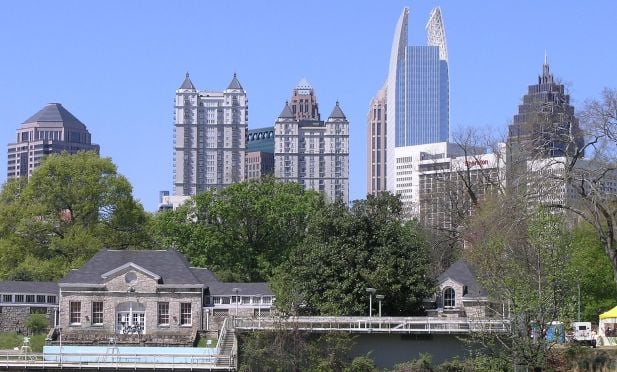
ATLANTA—Atlanta office job growth has been booming recent years. A decades-long shift in the local job market away from industrial jobs and toward high-salary, office-using employment took on new strength beginning in 2010.
That's according to research from Tony Bartlett, an executive vice president of Lincoln Property Company in Atlanta who is responsible for all of the firm's commercial activities in Georgia. In fact, he tells GlobeSt.com, the gap between industrial and office employment—more than 150,000 jobs—is wider today than ever before in Atlanta.
“This intensifying shift has driven significant demand for office space, as you can imagine,” Bartlett says. “Yet Atlanta has seen little construction activity since 2010 compared to prior periods.” (Atlanta's office market is feeling the pain of massive move outs. Read more here.)
He offers a prime example: The previous 20-year average—1990 to 2010—of office space delivered per year was 4 million square feet. But the post-recession era spanning 2011 to 2016 only saw an average of 496,000 square feet delivered annually. (Wondering how Atlanta ranks among office growth markets? Here's the skinny.)
“A confluence of factors is responsible for the slow pace of construction,” Bartlett says. “First, finance and construction costs have skyrocketed in recent years due to structural changes in other product types—industrial and multifamily came roaring back to life—post-recession financial reforms, and rising demand for construction labor with the simultaneous building of SunTrust Park and Mercedes-Benz Stadium, to name a few big projects around town.”
Second, he says, the replacement cost for office buildings has shot up dramatically. His research shows costs were as low as $325 per square foot in 2013 but today have risen to over $425 per square foot for CBD properties, a 31 percent jump in just three years. Third, he says, companies are finding new, more efficient ways to use their office space.
“There's a new wave of so-called 'creative' office designs have enabled employers to vastly increase their use density, and the rise of more flexible work schedules has allowed employees to spread their work hours out over the day, increasing the use of space that would have otherwise sat vacant after the end of the workday,” Bartlett says. “As a result, the number of jobs per 1,000 square feet of office space—an industry-standard measure of density—has been increasing steadily since 2009. At its low in 2009, that measure was less than 3.4 jobs per 1,000 square feet. Today, it is nearing the 4 per 1,000 mark. Make no mistake: employers have every incentive to increase their use density and will continue to do so to alleviate the pressure of rising rents.”
ATLANTA—Atlanta office job growth has been booming recent years. A decades-long shift in the local job market away from industrial jobs and toward high-salary, office-using employment took on new strength beginning in 2010.
That's according to research from Tony Bartlett, an executive vice president of Lincoln Property Company in Atlanta who is responsible for all of the firm's commercial activities in Georgia. In fact, he tells GlobeSt.com, the gap between industrial and office employment—more than 150,000 jobs—is wider today than ever before in Atlanta.
“This intensifying shift has driven significant demand for office space, as you can imagine,” Bartlett says. “Yet Atlanta has seen little construction activity since 2010 compared to prior periods.” (Atlanta's office market is feeling the pain of massive move outs. Read more here.)
He offers a prime example: The previous 20-year average—1990 to 2010—of office space delivered per year was 4 million square feet. But the post-recession era spanning 2011 to 2016 only saw an average of 496,000 square feet delivered annually. (Wondering how Atlanta ranks among office growth markets? Here's the skinny.)
“A confluence of factors is responsible for the slow pace of construction,” Bartlett says. “First, finance and construction costs have skyrocketed in recent years due to structural changes in other product types—industrial and multifamily came roaring back to life—post-recession financial reforms, and rising demand for construction labor with the simultaneous building of SunTrust Park and Mercedes-Benz Stadium, to name a few big projects around town.”
Second, he says, the replacement cost for office buildings has shot up dramatically. His research shows costs were as low as $325 per square foot in 2013 but today have risen to over $425 per square foot for CBD properties, a 31 percent jump in just three years. Third, he says, companies are finding new, more efficient ways to use their office space.
“There's a new wave of so-called 'creative' office designs have enabled employers to vastly increase their use density, and the rise of more flexible work schedules has allowed employees to spread their work hours out over the day, increasing the use of space that would have otherwise sat vacant after the end of the workday,” Bartlett says. “As a result, the number of jobs per 1,000 square feet of office space—an industry-standard measure of density—has been increasing steadily since 2009. At its low in 2009, that measure was less than 3.4 jobs per 1,000 square feet. Today, it is nearing the 4 per 1,000 mark. Make no mistake: employers have every incentive to increase their use density and will continue to do so to alleviate the pressure of rising rents.”
© Arc, All Rights Reserved. Request academic re-use from www.copyright.com. All other uses, submit a request to TMSalesOperations@arc-network.com. For more information visit Asset & Logo Licensing.