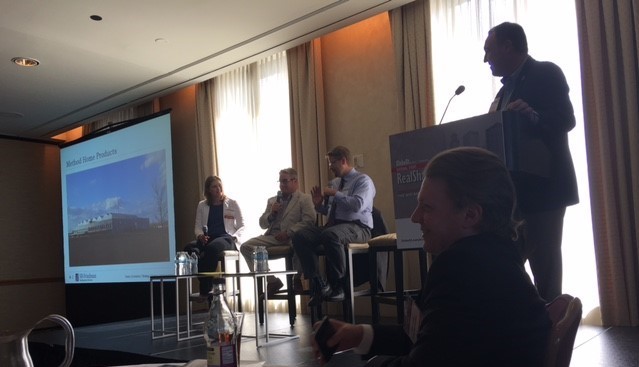
CHICAGO—The recent announcement by online giant Amazon that it was seeking to establish a second 50,000-person headquarters somewhere in North America has focused the minds of many on whether government incentives can help land such a big fish. At last week's RealShare Industrial conference in Chicago, participants in an afternoon panel tackled the latest developments in public-private partnerships, and it was felt that the Midwest in general has adjusted its attitude toward the use of incentives.
“Midwest states are now competitive,” said Kate Crowley, principal, Baker Tilly. She leads the firm's negotiated incentives practice, and recently was helping a manufacturing client expand its operations. Crowley could not provide details, but this particular competition came down to one southwestern state and one in the Midwest, and the latter was able to at least match the other in incentives, something that probably would not have happened several years ago.
Other recent developments have made an increased use of incentives more acceptable. The recent decision by Taiwanese flat-screen manufacturer Foxconn to locate what it claims will be a $10 billion plant in Wisconsin, for example, was helped along by a just approved $3 billion incentives package. The plant won't open until 2020, and whether the promised jobs appear is still an open question.
But Crowley said the fact that such a massive incentives package was put on the table was significant. “It's changed the game,” and she thinks we're already seeing bigger incentives packages from other governments in the Midwest region to attract other firms.
And the Foxconn decision will probably impact surrounding states almost as much as Wisconsin. If the manufacturer fulfills its plans, it will also need a new ecosystem of suppliers, “and they are going to be in Illinois and Indiana as well,” said Crowley. That means the next few years could see an ongoing competition among these states to design incentives packages that will garner their share of these suppliers.
Some government officials believe putting together incentives packages with big numbers will land companies like Amazon. But Crowley says convincing businesses to relocate is much more complicated. Corporate leaders are most likely to begin looking at areas where they have access to talent, especially in cities or regions that have good transportation options and affordable land.
Therefore, to successfully land Amazon, Crowley “does not think the incentives package needs to be crazy.” In fact, cities won't really compete on incentives until “the finalists are chosen.”
CHICAGO—The recent announcement by online giant Amazon that it was seeking to establish a second 50,000-person headquarters somewhere in North America has focused the minds of many on whether government incentives can help land such a big fish. At last week's RealShare Industrial conference in Chicago, participants in an afternoon panel tackled the latest developments in public-private partnerships, and it was felt that the Midwest in general has adjusted its attitude toward the use of incentives.
“Midwest states are now competitive,” said Kate Crowley, principal, Baker Tilly. She leads the firm's negotiated incentives practice, and recently was helping a manufacturing client expand its operations. Crowley could not provide details, but this particular competition came down to one southwestern state and one in the Midwest, and the latter was able to at least match the other in incentives, something that probably would not have happened several years ago.
Other recent developments have made an increased use of incentives more acceptable. The recent decision by Taiwanese flat-screen manufacturer Foxconn to locate what it claims will be a $10 billion plant in Wisconsin, for example, was helped along by a just approved $3 billion incentives package. The plant won't open until 2020, and whether the promised jobs appear is still an open question.
But Crowley said the fact that such a massive incentives package was put on the table was significant. “It's changed the game,” and she thinks we're already seeing bigger incentives packages from other governments in the Midwest region to attract other firms.
And the Foxconn decision will probably impact surrounding states almost as much as Wisconsin. If the manufacturer fulfills its plans, it will also need a new ecosystem of suppliers, “and they are going to be in Illinois and Indiana as well,” said Crowley. That means the next few years could see an ongoing competition among these states to design incentives packages that will garner their share of these suppliers.
Some government officials believe putting together incentives packages with big numbers will land companies like Amazon. But Crowley says convincing businesses to relocate is much more complicated. Corporate leaders are most likely to begin looking at areas where they have access to talent, especially in cities or regions that have good transportation options and affordable land.
Therefore, to successfully land Amazon, Crowley “does not think the incentives package needs to be crazy.” In fact, cities won't really compete on incentives until “the finalists are chosen.”
© Arc, All Rights Reserved. Request academic re-use from www.copyright.com. All other uses, submit a request to TMSalesOperations@arc-network.com. For more information visit Asset & Logo Licensing.