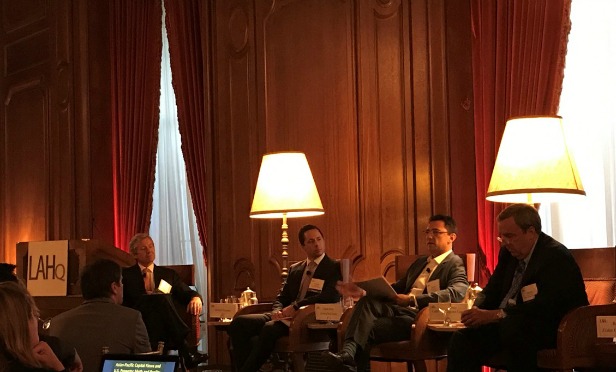
 The US maybe losing its rank as a safe haven for foreign capital. According to experts at the Los Angeles Headquarters Association's Capital Idea: Financing Development in L.A., Asian investment in Los Angeles has slowed this year; however, the US is still an attractive place for investment and the slowdown isn't expected to affect MSA pricing.
“So far in 2017, Asian capital flows into real estate have slowed, especially in development,” Randy Zisler, CEO of Zisler Capital Associates, tells GlobeSt.com in an interview following the panel discussion. “Asian capital flows into L.A. and San Francisco as a share of total MSA commercial transactions volume has increased from 2010-2014 to 2016-2017, but the current percentage is still small—5.7% in L.A. and 7.4% in San Francisco—but is unlikely to affect MSA pricing.
Charlie Rose, senior director of structured investments at Invesco Real Estate, noticed a similar trend in Asian investing, and wondered if the global perception of the US market is shifting. “In the past six months we have seen a few cracks in the global perception of the United States as a safe haven for capital, but on a relative basis US real estate remains an attractive investment for both onshore and offshore investments,” he tells GlobeSt.com.
In terms of pricing, Asian investors typically pay more for US assets, and in the past have used it as a tactic to detour competition and gain a foothold in the market. “After controlling statistically for other factors, such as CBD location and building size, Asian cap rates are 43 basis points lower, which means that Asians pay about 6% more at the time of acquisition,” says Zisler. “This apparent overpayment, which is not much, may be dynamically efficient in terms of exploiting first-mover advantage and creating an Asian ownership beachhead.”
The discussion didn't only focus on Asian investment. In general, construction financing has become difficult and pricing is beginning to become a major challenge. “Construction financing has become increasingly scarce at the same time as high construction costs and land costs as well as regulatory constraints have conspired to reign in future supply,” Rose says.
Rose says that Invesco is beginning to become more conservative as a result, and has outlined specific criteria for would-be construction borrowers. “At this stage of the cycle, our debt business is focusing on generating current income by originating prudent loans with substantial equity and value subordination to high quality borrowers with resilient balance sheets,” he says. “We take a bottom up approach to debt investing, informed by our research team's top down view to generate alpha in this environment.”
The US maybe losing its rank as a safe haven for foreign capital. According to experts at the Los Angeles Headquarters Association's Capital Idea: Financing Development in L.A., Asian investment in Los Angeles has slowed this year; however, the US is still an attractive place for investment and the slowdown isn't expected to affect MSA pricing.
“So far in 2017, Asian capital flows into real estate have slowed, especially in development,” Randy Zisler, CEO of Zisler Capital Associates, tells GlobeSt.com in an interview following the panel discussion. “Asian capital flows into L.A. and San Francisco as a share of total MSA commercial transactions volume has increased from 2010-2014 to 2016-2017, but the current percentage is still small—5.7% in L.A. and 7.4% in San Francisco—but is unlikely to affect MSA pricing.
Charlie Rose, senior director of structured investments at Invesco Real Estate, noticed a similar trend in Asian investing, and wondered if the global perception of the US market is shifting. “In the past six months we have seen a few cracks in the global perception of the United States as a safe haven for capital, but on a relative basis US real estate remains an attractive investment for both onshore and offshore investments,” he tells GlobeSt.com.
In terms of pricing, Asian investors typically pay more for US assets, and in the past have used it as a tactic to detour competition and gain a foothold in the market. “After controlling statistically for other factors, such as CBD location and building size, Asian cap rates are 43 basis points lower, which means that Asians pay about 6% more at the time of acquisition,” says Zisler. “This apparent overpayment, which is not much, may be dynamically efficient in terms of exploiting first-mover advantage and creating an Asian ownership beachhead.”
The discussion didn't only focus on Asian investment. In general, construction financing has become difficult and pricing is beginning to become a major challenge. “Construction financing has become increasingly scarce at the same time as high construction costs and land costs as well as regulatory constraints have conspired to reign in future supply,” Rose says.
Rose says that Invesco is beginning to become more conservative as a result, and has outlined specific criteria for would-be construction borrowers. “At this stage of the cycle, our debt business is focusing on generating current income by originating prudent loans with substantial equity and value subordination to high quality borrowers with resilient balance sheets,” he says. “We take a bottom up approach to debt investing, informed by our research team's top down view to generate alpha in this environment.”
© Arc, All Rights Reserved. Request academic re-use from www.copyright.com. All other uses, submit a request to TMSalesOperations@arc-network.com. For more information visit Asset & Logo Licensing.