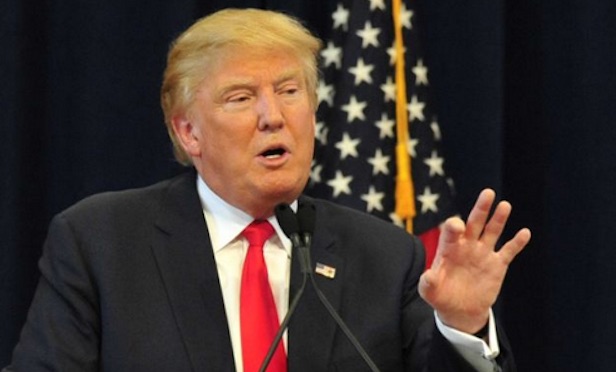
WASHINGTON, DC–A few weeks ago President Donald Trump told lawmakers he had changed his mind about the structure of his $1 trillion infrastructure investment plan. Previously the plan was contingent on private sector participation; now, President Trump reportedly said, he didn't want to take that route. The reason? As we discussed in part 1 of this article: Certain partnerships between the private sector and federal government just don't work.
A survey of experts in this area reveals that the president was right — at least when the federal government is taking the lead in the project. The best structures, it is widely thought, are when the state or local jurisdiction are heading the transaction.
This is not to say the model is broken, Warren Hennagin, Construction Industry leader and a partner at Marcum tells GlobeSt.com — “but I do think it's a matter of putting all egos aside to come together in a collaborative way to come up with a plan that's beneficial to all parties.”
Examples of projects with models that worked are The Bridge replacements in Pennsylvania, The Long Beach Civic Center, The Port of Los Angeles and LAX, he says.
“Agencies serve a great purpose in Private/Public sector partnerships and when they have the appropriate business acumen, they are able to bring all elements from contracting to design seamlessly.”
Whatever the reality of P3 projects may be, the president has signaled he doesn't want to pursue that tract. And a structure in which the federal government distributes money to states would make a P3 cumbersome at best, to say nothing of where the funding would be found in the first place.
All that said, experts do have some thoughts on how this initiative can proceed, which we look at in part 2 of this article. Warning: it won't be pretty.
A good place to start is to understand precisely why the president and others are not bullish on using a P3 for infrastructure investments.
For starters, says Pillsbury Partner and Projects practice co-leader Nick Sarad, one substantial hurdle to increasing the US government's role in P3s, particularly those structured as “availability payments” is that under a Office of Management and Budget rule, long-term payment contracts are most often treated as a capital lease or lease purchase. This means that an entire project's cost — the government's total monetary obligations over the life of the P3 contract, even in the out-years — must be accounted for in the year when the commitment is made, he tells GlobeSt.com. “This has an outsize impact on the budget, and in essence precludes federal agencies from utilizing most long term P3 projects.”
No Good Choices
It is also important to remember that P3 arrangements work best when there is a revenue stream attached to it, says Julian Anderson, Global Board Chairman at Rider Levett Bucknall, a project and cost management firm. “A revenue stream is fundamental to getting the private sector engaged because it is the mechanism for monetizing the project — and hence attracting capital,” he tells GlobeSt.com.
The problem with using the P3 approach for infrastructure repairs and upgrades, such as roads and bridges, is that, unless one attaches a toll or a lease to the project, there is almost no way for providing a monetized incentive for the private sector to provide the necessary capital, Anderson says.
Another possibility is to push the cost onto state and local governments, but that too is a non-starter as many still not recovered from the financial crisis.
Another solution is that a gas tax could pay for the repairs but that disproportionately harms the working poor.
There are, in short, no good choices.
If the United States wishes to have improved infrastructure,” Anderson says, then taxpayers may need to become more accepting of:
- Generally higher taxes;
- Larger deficits;
- Tolls on federal state and county roads and bridges that were previously toll-free;
- Roads and bridges that operate in competition with existing roads and bridges but charge a toll in return for quicker commutes.
- A broader privatization of existing roads and bridges — that is, sell or lease major roads and bridges to the private sector — with the idea that once the work has been done the private sector entity can collect tolls or lease payments;
- An increase in the fuel tax;
- A federal VAT type tax specifically to pay for infrastructure;
- A tax on miles driven;
- A specific tax on car sales (would likely face stiff opposition from the auto manufacturers);
- A 'temporary', but large, surcharge on income taxes, for example; and / or
- A combination of the above.
It is a daunting list and as one goes through it, an unpleasant realization takes hold.
“Yes, we want the world's best infrastructure,” Sarad said. “We just don't want to have to pay for it out of our own pockets.”
© Arc, All Rights Reserved. Request academic re-use from www.copyright.com. All other uses, submit a request to TMSalesOperations@arc-network.com. For more information visit Asset & Logo Licensing.